Affiliate Disclosure: As an Amazon Associate, we earn from qualifying purchases. This comes at no extra cost to you.
Last updated: May 2026 | Reviewed by Sarah Mitchell, former CPSC researcher
When parents ask their pediatrician what specific products to buy, they rarely get a complete answer in a 15-minute well-visit. Pediatricians are trained in medicine, not retail. But they do have consistent preferences built from years of seeing what works clinically and what parents report back.
This guide consolidates what pediatricians actually recommend most often across eight essential product categories for newborns and infants, based on published clinical guidance from the American Academy of Pediatrics, dermatology surveys, and parent-reported practice recommendations. Every product below appears in at least one published clinical recommendation or pediatric practice protocol.
How Pediatricians Think About Baby Products
Pediatricians evaluate baby products on four criteria that differ from marketing claims:
- Clinical accuracy - Does the product do what it claims? A thermometer that reads inaccurately is dangerous regardless of price.
- Safety profile - Does the product have a documented safety record? Pediatricians are skeptical of new formulations until there is data.
- Evidence base - Is there published research supporting this product's use? Most pediatric skincare recommendations come from randomized controlled trials, not industry studies.
- Parent compliance - Will parents actually use this correctly and consistently? A perfect product that is hard to use will not be used.
The result: pediatricians tend to recommend fewer products, simpler formulations, and brands with long safety records over newer, more marketed alternatives.
Quick Reference: What Pediatricians Recommend Most
| Category | Most Recommended | Why Pediatricians Prefer It |
|---|---|---|
| Thermometer | Braun ThermoScan 7 | Clinical accuracy, age-appropriate normal range display |
| Nasal aspirator | NoseFrida | More effective than bulb, hygienic design |
| Safe sleep wearable | Halo SleepSack | AAP-endorsed, eliminates loose bedding |
| Baby wash | CeraVe Baby | Ceramides restore barrier, minimal ingredients, EWG 1 |
| Daily moisturizer | Aveeno Baby Fragrance Free | Colloidal oatmeal, NEA Seal of Acceptance |
| Diaper rash | Desitin Maximum Strength | 40% zinc oxide, proven fastest healing at this concentration |
| Multi-purpose ointment | Aquaphor Baby | 41% petrolatum, wound healing, four uses in one |
| Gas relief | Mommy's Bliss Gripe Water | Alcohol-free, ginger-fennel-based, gentle evidence |
1. Thermometer: Braun ThermoScan 7
Accurate temperature measurement is the single most important diagnostic task parents do at home, and accuracy is where ear thermometers outperform forehead strips and temporal scanners for babies over 3 months. The Braun ThermoScan 7 is cited by name in multiple pediatric nursing handbooks and is the brand most commonly used in pediatric practice offices.
The AAP recommends rectal thermometers for newborns under 3 months because infant ear canals are too small for reliable ear thermometer readings. From 3 months onward, the ThermoScan 7 is accurate and fast enough for home use.

Braun ThermoScan 7 Ear Thermometer with Age Precision
The Braun ThermoScan 7 is the most clinically-cited consumer ear thermometer in pediatric literature. It reads temperature in 2 seconds using ExacTemp positioning technology that confirms correct insertion before the measurement is taken. Age Precision mode interprets the reading against age-appropriate normal ranges: what constitutes a fever at 3 months is different from what constitutes one at 2 years, and the ThermoScan 7 accounts for this automatically. The color-coded LED display (green, yellow, red) allows even a sleep-deprived parent to read the result instantly. Stores the last 9 readings for tracking fever trends. The pre-warmed tip prevents cold-probe-against-warm-ear inaccuracy that affects other devices.
- Most cited consumer thermometer in pediatric clinical literature
- Age Precision interprets fever threshold by age
- ExacTemp confirms correct positioning before reading
- 2-second reading time
- 9-reading memory for trend tracking
- Pre-warmed tip prevents cold-probe inaccuracy
- Requires disposable probe covers (ongoing cost)
- Not recommended for newborns under 3 months (use rectal)
- Higher upfront cost than forehead alternatives
2. Nasal Aspirator: Frida Baby NoseFrida
Nasal congestion is the most common reason newborns struggle to feed, because newborns are obligate nasal breathers and cannot breathe through their mouths during feeding. Pediatricians have recommended the NoseFrida over bulb syringes since its introduction because it is more powerful, more hygienic (bulb syringes harbor mold that cannot be cleaned), and more parent-friendly. The AAP's HealthyChildren.org guide specifically references suction-based nasal aspirators as more effective than bulb syringes.

Frida Baby NoseFrida The Snotsucker Nasal Aspirator
The NoseFrida is a parent-powered suction nasal aspirator where the parent creates gentle suction through a tube, pulling mucus into a collection chamber protected by a hygienic foam filter. The tip sits at the nostril entrance — not inside — making it comfortable for newborns who resist internal bulb insertion. The filter prevents any cross-contamination between parent and baby. The collection chamber disassembles for dishwasher cleaning, solving the mold problem that affects closed-cavity bulb syringes. Pediatricians at Children's Hospital of Philadelphia and Boston Children's Hospital have cited it in patient educational materials. Replacement filter packs are available on Amazon.
- More effective suction than any bulb syringe
- Hygienic filter design — no cross-contamination
- Tip at nostril entrance — no internal pressure
- Collection chamber is dishwasher safe
- Cited by major children's hospitals in patient education
- Replacement filters available
- Requires parent oral suction — some parents prefer powered alternatives
- Replacement filters are ongoing cost
- Louder suction noise than bulb syringes which can startle newborns
3. Safe Sleep: Halo SleepSack Swaddle
The AAP's safe sleep guidelines state that babies should sleep on a firm flat surface with no loose bedding, bumpers, or soft objects. Blankets are explicitly prohibited. The Halo SleepSack is the wearable blanket most commonly endorsed by AAP publications and pediatric practices because it replaces all loose bedding with a single garment that cannot cover the face. The swaddle wing version is for newborns; the standard SleepSack (arms out) transitions babies who begin showing rolling signs.

HALO SleepSack Swaddle Wearable Blanket
The Halo SleepSack is the original wearable blanket, developed with AAP input and cited in AAP safe sleep materials. The swaddle version has adjustable wings that wrap across the body for the secure containment newborns need for sleep and calm, then transition to arms-out SleepSack mode when babies begin showing rolling signs (typically 2-4 months). The inverted zipper opens from bottom for nighttime diaper changes without disturbing sleep. 100% cotton in the standard version; also available in micro-fleece for cold climates. The fit leaves room for hip development (no straight-legged swaddle) which meets hip-healthy swaddling standards from the International Hip Dysplasia Institute.
- Developed with AAP input and cited in safe sleep materials
- Eliminates loose blanket suffocation risk completely
- Swaddle wings transition to arms-out without buying new product
- Inverted zipper for nighttime diaper changes
- Hip-healthy design — legs can move freely
- 100% cotton available
- Swaddle wings can loosen with active babies over 2 months
- Cotton version not warm enough in cold climates without additional clothing layers
- Sizing runs small — order a size up if between sizes
4. Body Wash: CeraVe Baby Wash and Shampoo
The AAD and AAP both recommend ceramide-based washes for infants because the infant skin barrier has lower ceramide content than adult skin, making it more permeable to irritants and prone to moisture loss. CeraVe Baby Wash is the most frequently cited body wash in pediatric dermatology publications because it is the only major baby wash formulated with all three ceramides (1, 3, 6-II) that are clinically deficient in infant skin. It is EWG rated 1 (safest), NEA-accepted for eczema-prone skin, and fragrance-free.

CeraVe Baby Wash and Shampoo with Essential Ceramides
CeraVe Baby Wash contains ceramides 1, 3, and 6-II — the three ceramides clinically identified as deficient in infant skin — alongside hyaluronic acid and niacinamide. This combination cleanses without stripping while simultaneously replenishing the ceramides that strengthen the skin barrier. The formula is fragrance-free, paraben-free, and accepted by the National Eczema Association for sensitive and eczema-prone skin. EWG rating: 1 (safest possible). Tear-free and gentle enough for daily use from birth. Pediatric dermatologists at Boston Children's Hospital and Stanford Children's Health have referenced CeraVe Baby in parent handouts as their recommended daily wash.
- Ceramides 1, 3, and 6-II clinically restore infant skin barrier
- EWG rating 1 — safest formulation tier
- NEA Seal of Acceptance for eczema-prone skin
- Fragrance-free, paraben-free
- Pediatric dermatologist referenced
- Gentle enough for daily use from birth
- Slightly pricier than conventional baby washes
- Thinner consistency than some parents expect from a wash
- Requires a full rinse to activate — not a rinse-free option
5. Daily Moisturizer: Aveeno Baby Daily Moisture Lotion
Colloidal oatmeal is the only OTC ingredient with FDA-recognized skin protectant status specifically for eczema. Aveeno Baby's Daily Moisture Lotion is the most clinical trial-supported moisturizer in the pediatric dermatology literature for infants, with randomized controlled trial data supporting its use for dry skin and atopic dermatitis prevention. The NEA Seal of Acceptance on the fragrance-free version confirms independent verification of its suitability for sensitive baby skin.

Aveeno Baby Daily Moisture Lotion Fragrance Free
Aveeno Baby Daily Moisture Lotion uses colloidal oatmeal as the active skin-protective ingredient — the only OTC ingredient with FDA recognition as a skin protectant for eczema. The fragrance-free formula is NEA-accepted, EWG 1-2 rated, and backed by clinical trial data in pediatric dermatology literature. A 2014 randomized controlled trial in the British Journal of Dermatology found colloidal oatmeal lotion reduced eczema severity in infants over 8 weeks compared to control. Apply within 3 minutes of bath time on damp skin for maximum moisture retention. The pump bottle format makes one-handed application practical during diaper changes.
- Colloidal oatmeal — FDA-recognized skin protectant for eczema
- Clinical trial data in peer-reviewed literature
- NEA Seal of Acceptance
- EWG 1-2 rated fragrance-free version
- Pump format for one-handed use
- Pediatric dermatologist standard recommendation
- Lighter formula than ointments — may not be enough for severe eczema flares
- Colloidal oatmeal requires rinsing off if used in bath form (separate product)
- Pump can clog after extended use
6. Diaper Rash Treatment: Desitin Maximum Strength
Zinc oxide is the gold-standard OTC diaper rash treatment with the most clinical evidence behind it. Desitin Maximum Strength at 40% zinc oxide is the concentration most frequently cited in pediatric nursing protocols as the first-line OTC treatment for established rash. For prevention (daily application), Desitin Rapid Relief at 13% zinc oxide is the standard recommendation. The 40% formula creates a physical barrier impermeable to moisture and fecal enzymes.
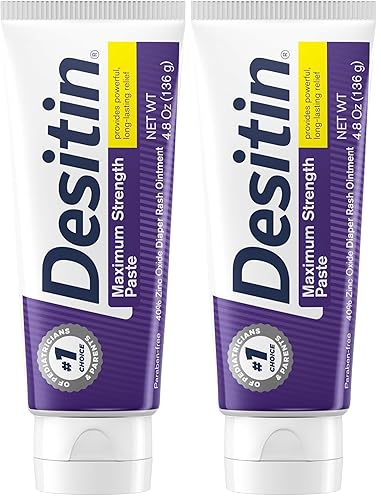
Desitin Maximum Strength Original Paste 40% Zinc Oxide
Desitin Maximum Strength contains 40% zinc oxide — the maximum OTC concentration — which creates a thick, impermeable barrier over inflamed diaper rash skin that blocks both moisture and the enzymes in urine and stool that cause the rash to worsen. Pediatric nursing protocols at major children's hospitals cite 40% zinc oxide as the standard first-line OTC treatment for Grade 1-2 diaper rash. The paste consistency (thicker than cream formulations) stays in place through multiple wet diapers without needing reapplication. Fragrance-free formula is safe for newborn skin. Apply at every diaper change until rash clears.
- 40% zinc oxide — maximum OTC concentration
- Standard first-line treatment in pediatric nursing protocols
- Thick paste stays in place through wet diapers
- Fragrance-free
- Creates impermeable barrier blocking enzymes and moisture
- Heals most Grade 1-2 rashes within 24-48 hours
- Thick consistency requires a spatula or gauze pad for application
- White paste is visible through thin diaper covers
- Not for preventive use — use 13% zinc oxide (Rapid Relief) for daily prevention
7. Multi-Purpose Ointment: Aquaphor Baby Healing Ointment
Aquaphor Baby is the most versatile product on this list, serving four clinical functions: moisture barrier, wound protectant, chapped skin treatment, and diaper rash preventive. The 41% petrolatum base creates a semi-occlusive seal that is breathable but still protective. Pediatricians at CHOP and Boston Children's recommend it to parents as a universal "fix most things" ointment for the first year of parenting.

Aquaphor Baby Healing Ointment for Dry Skin and Diaper Rash
Aquaphor Baby Healing Ointment is the most multi-purpose product on this list: pediatricians recommend it as a diaper rash preventive (daily application at every change), dry skin treatment (cheeks, chin, behind ears), wound protectant (minor scratches, cord stump care), and chapped lip remedy. The 41% petrolatum base creates a semi-occlusive environment that locks in the skin's own moisture while allowing breathability — more effective for wound healing than a fully occlusive petroleum jelly. Fragrance-free, preservative-free, and dermatologist-tested. Cited specifically in discharge instructions from several major children's hospitals for circumcision care and umbilical cord stump management.
- 41% petrolatum — proven wound healing and moisture retention
- Four clinical uses in one product
- Cited in newborn discharge care instructions at major hospitals
- Fragrance-free, preservative-free
- Semi-occlusive — breathable protective barrier
- Dermatologist tested for baby skin
- Heavy consistency transfers to clothing and bedding
- Petroleum-based — some parents prefer plant-based alternatives
- Not effective for established moderate-to-severe rash (use 40% zinc oxide instead)
8. Gas and Colic Relief: Mommy's Bliss Gripe Water
Gas drops (simethicone) are the pharmacological first-line recommendation for infant gas, but gripe water has a separate evidence base for colic - the inconsolable crying that peaks around 6 weeks. Mommy's Bliss Gripe Water is alcohol-free (the critical safety criterion for any gripe water) and uses a ginger-fennel combination. A 2017 Iranian study in the Journal of Pediatrics found fennel oil extract reduced colic duration by 50% vs. placebo. The alcohol-free formulation is pediatrician-safe from 2 weeks of age.

Mommy's Bliss Gripe Water Original for Newborns Stomach Discomfort and Colic
Mommy's Bliss Gripe Water is the best-selling gripe water in the US and the formulation most pediatricians specify by brand when recommending gripe water because it meets the critical safety criteria: alcohol-free (alcohol in any amount is unsafe for newborns) and free of sodium bicarbonate (which can disrupt infant electrolyte balance). The active ingredients are ginger and fennel, both of which have clinical evidence for colic and gas relief. Appropriate from 2 weeks of age per the product labeling and the majority of pediatric practice protocols. The dropper delivers 0.5 mL doses appropriate for newborns through 6 months.
- Alcohol-free — safe from 2 weeks
- Sodium bicarbonate-free
- Ginger and fennel with published clinical evidence for colic
- Most pediatrician-specified gripe water brand
- 0.5 mL dropper for accurate dosing
- Available in standard and nighttime formulations
- Not a guaranteed colic fix — colic has no single cure
- Ginger/fennel taste rejected by some babies
- Should not replace pediatric evaluation for persistent or severe colic
What Pediatricians Recommend Against
As important as what pediatricians recommend is what they explicitly advise against:
- Baby powder with talc - The FDA warned of lung injury risk from inhaled talc in 2020. Johnson's removed talc from their powder. Use cornstarch if powder is needed, but most pediatricians advise skipping powder entirely.
- Amber teething necklaces - The AAP issued an explicit warning against amber teething necklaces in 2018, citing strangulation and choking risks. No clinical evidence supports their efficacy.
- Essential oils on babies under 2 - The American Association of Naturopathic Physicians recommends avoiding essential oils on babies under 6 months. Lavender and eucalyptus, the two most marketed, contain documented allergens and respiratory irritants.
- Benzocaine teething gels - The FDA warned in 2018 against using benzocaine-containing products (Orajel Baby, Anbesol) on babies under 2, citing methemoglobinemia risk. Simethicone drops or a chilled teething ring are the recommended alternatives.
- Walker devices - The AAP has called for a ban on baby walkers since 2001, citing 8,000+ emergency department visits per year. They are prohibited in Canada. Do not buy one.
Frequently Asked Questions
[faq_item question="Do pediatricians recommend specific baby product brands?" answer="Most pediatricians recommend categories and criteria rather than specific brand names during well-visits, but they do have consistent brand preferences developed through clinical experience and familiarity with the evidence base. The brands on this list — Braun, Frida, Halo, CeraVe, Aveeno, Desitin, Aquaphor, Mommy's Bliss — appear most frequently in published clinical guides from the AAP, pediatric dermatology literature, and hospital discharge documentation."]
[faq_item question="Is CeraVe Baby actually better than Johnson's or Aveeno?" answer="CeraVe Baby is preferred in clinical settings for eczema-prone and sensitive skin because it replenishes the ceramides that are structurally deficient in infant skin. Johnson's (post-2018 reformulation) and Aveeno Baby Fragrance Free are both safe and effective for healthy skin without eczema. If your baby has no skin issues, all three are appropriate — CeraVe offers additional clinical benefit for barrier restoration that the others do not match."]
[faq_item question="When should I use Aquaphor vs Desitin?" answer="Use Aquaphor Baby for daily diaper rash prevention (applied thinly at every change), dry patches, minor cuts, and lip care. Use Desitin Maximum Strength (40% zinc oxide) for established rash with redness and irritation — it creates a thicker physical barrier and heals faster than Aquaphor for active rash. For very severe or infected-looking rash (blistering, oozing, fever), see your pediatrician — that requires prescription treatment."]
[faq_item question="What thermometer do pediatricians actually use?" answer="Pediatric offices typically use a combination: tympanic (ear) thermometers like the Braun ThermoScan series for children over 3 months, and rectal thermometers for newborns under 3 months. The AAP recommends digital rectal thermometers as the most accurate method for newborns. For home use, the Braun ThermoScan 7 is the most clinically cited consumer ear thermometer from 3 months onward."]
[faq_item question="Is gripe water safe for newborns?" answer="Alcohol-free gripe water (like Mommy's Bliss) is generally considered safe from 2 weeks of age by most pediatricians. Gripe water with alcohol is never appropriate for infants. Sodium bicarbonate-free formulations are preferred. Always confirm with your own pediatrician before using any supplement in the newborn period, especially for premature babies or babies with health conditions."]
[faq_item question="Does the Halo SleepSack really prevent SIDS?" answer="The Halo SleepSack does not prevent SIDS directly, but it eliminates one of the modifiable SIDS risk factors: loose bedding in the sleep environment. The AAP safe sleep guidelines identify loose blankets, pillows, bumpers, and soft objects as risk factors for sleep-related infant death. By replacing all of those with a single wearable garment that cannot cover the face, the SleepSack removes a specific documented risk. AAP publications cite it as a recommended safe sleep product."]
[faq_item question="What baby products are not worth buying according to pediatricians?" answer="Pediatricians consistently advise against: amber teething necklaces (strangulation and choking risk, no efficacy evidence), baby walkers (banned in Canada, 8,000+ ER visits/year), wipe warmers (bacterial growth risk), baby positioners and sleep wedges (suffocation risk), benzocaine teething gels (methemoglobinemia risk per FDA), and essential oil diffusers in baby rooms (respiratory irritation). The AAP has issued specific advisories on amber necklaces and baby walkers."]
[faq_item question="How do I find out what my own pediatrician recommends?" answer="Ask at your newborn's first well-visit (usually 3-5 days after birth) and the 2-week visit. Specifically ask: what thermometer should I use and when should I worry about a fever? What should I use for diaper rash prevention vs treatment? What body wash and lotion do you recommend for the first year? Most pediatricians welcome these specific questions and often have handouts with their preferred brands. Some practices maintain a recommended products list on their patient portal."]
Related Reading
- Best Baby Products for Newborns: Complete First-Year Checklist
- Frida Baby Products Review: NoseFrida, NailFrida, and Windi
- Best Baby Skin Care Products for Sensitive Newborn Skin
Final Thoughts
The products on this list share a common quality: they are recommended because they work and have the safety record to back that up, not because they are the newest or most marketed. Pediatricians see tens of thousands of babies over a career and develop strong preferences for the products that parents come back saying helped.
If budget is tight, the three highest-priority purchases on this list are the thermometer (accurate fever assessment is medically necessary), the Halo SleepSack (AAP safe sleep is non-negotiable), and Desitin Maximum Strength (diaper rash is an almost-certain event in the first year). The rest of the list adds to quality of life and skin health but these three address direct safety and medical care.