
What changed in this May 2026 update: We re-validated the registry checklist against current AAP newborn-care guidance and verified zero CPSC recalls on listed products. Refreshed price ranges. Next scheduled review: August 2026.
Affiliate Disclosure: As an Amazon Associate, we earn from qualifying purchases. This comes at no extra cost to you.
Building a baby registry is overwhelming — every list is different and everyone says everything is essential. This is the registry checklist we'd give a friend: only the must-have baby products you'll actually use, organized by trimester need, with notes on which can wait.
Baby product marketing is extraordinarily good at creating the feeling that you need dozens of specialized items before your baby arrives. In practice, newborns require very little — they need to sleep safely, travel safely, eat, stay warm, and have clean, moisturized skin. The products that genuinely serve these needs can fit in a medium-sized box.
This guide cuts through the registry overwhelm. We've identified the products that every new parent actually needs — the items that get used daily, solve real problems, and make a meaningful difference to both baby's wellbeing and parental sanity. We've also flagged the popular products that are genuinely optional, so you can make an informed choice about what to prioritize.
The Must-Have Baby Products Checklist
| Product | Category | Why It's a Must-Have | Price Range |
|---|---|---|---|
| Graco SnugRide 35 / 4Ever DLX | Car Seat | Required by law; can't leave hospital without one | $$$ |
| Halo BassiNest Swivel Sleeper | Sleep | Safe, bedside newborn sleep within arm's reach | $$$ |
| Aquaphor Baby Healing Ointment | Skincare | Diaper rash, dry skin, chapped areas — one product solves all | $ |
| WaterWipes Baby Wipes | Diapering | Cleanest wipe for the most sensitive skin area | $$ |
| Haakaa Silicone Breast Pump | Feeding (nursing) | Passive letdown collection, saves significant milk | $ |
| Dr. Brown's Original Baby Bottles | Feeding | Best anti-colic venting for formula-fed or bottle-fed babies | $$ |
| Frida Baby NoseFrida Snotsucker | Health | Clears stuffy noses when baby can't breathe; essential for first cold | $ |
| HATCH Baby Rest Sound Machine | Sleep | White noise + light; the most effective sleep environment tool | $$ |
| Ergobaby Embrace Newborn Carrier | Gear | Hands-free soothing while keeping baby close and supported | $$$ |
| Boppy Nursing Pillow | Feeding | Arm support for both nursing and bottle feeding; also tummy time | $$ |
The 10 True Must-Haves: Our Full Reviews
1. Graco SnugRide 35 Lite Elite — Must-Have Car Seat
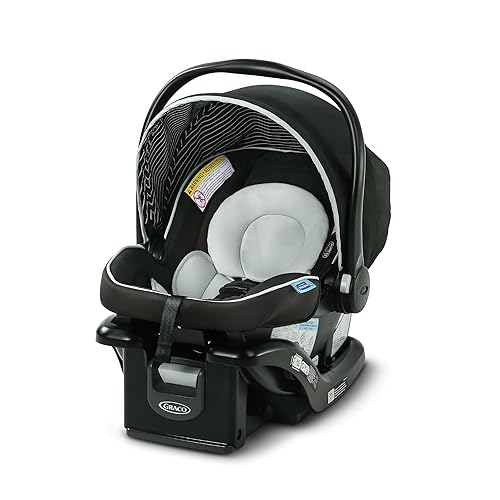
Graco SnugRide 35 Lite Elite Infant Car Seat
You cannot leave the hospital without a properly installed rear-facing infant car seat, and the SnugRide 35 Lite Elite is the best balance of safety, weight, and value available in 2026. At 6.4 lbs without the base, it is one of the lightest infant seats on the market — a practical advantage that matters every time you carry baby through a parking lot, a restaurant, or an airport. FAA-approved for air travel, compatible with most major stroller brands, and featuring a clear level indicator to prevent the most common installation error. The InRight LATCH system clicks in place with one hand and confirms installation audibly.
- Legal requirement — cannot travel in a car without it
- One of the lightest infant seats at 6.4 lbs
- FAA-approved for aircraft use
- Level indicator prevents common installation mistakes
- Compatible with most major stroller frames
- 35 lb limit means babies who grow quickly may outgrow it by 9–12 months
- Higher price than base SnugRide models
Car seat installation errors are extremely common — surveys suggest 50–70% of car seats are installed incorrectly in some way. The SnugRide 35's level indicator directly addresses the most common error: incorrect rear-facing angle. If the bubble is in the green zone, the seat is at the correct angle. There is no equivalent of this in lower-priced models, and it represents a meaningful safety advantage.
Pros
- Legal necessity met with the best value lightweight option
- Level indicator reduces installation error risk
- FAA travel approval
- Works with most stroller systems
Cons
- Infants who grow quickly may outgrow it before 12 months
- Premium cost — budget options exist if weight isn't a priority
2. Halo BassiNest Swivel Sleeper — Must-Have Newborn Sleep Space
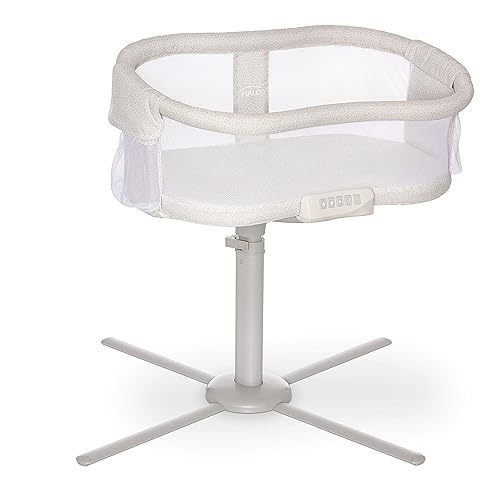
Halo BassiNest Swivel Sleeper
- Higher price than simpler bedside bassinets
- Mesh sides show wear over time with frequent swiveling
- Some parents find the vibration feature underwhelming
The AAP's 2022 safe sleep guidelines recommend room-sharing — but not bed-sharing — for the first six months. This means having the baby sleep in their own separate surface, in the same room as the parents. The BassiNest fulfills this recommendation while making the most exhausting aspect of newborn life — nighttime feeds — as manageable as possible. Rotating the bassinet to face you, then lowering the bedside wall to access the baby, takes seconds and requires almost no movement on the parent's part.
Pros
- AAP recommended room-sharing without bed-sharing
- Swivel rotation makes nighttime access seamless
- Open side means feeds without fully leaving bed
- Built-in sleep tools (sound, light, vibration) reduce need for separate devices
Cons
- Premium price relative to simpler bassinets
- Weight capacity (20 lbs) means transitioning to crib around 4–6 months
3. Aquaphor Baby Healing Ointment — Must-Have Skincare
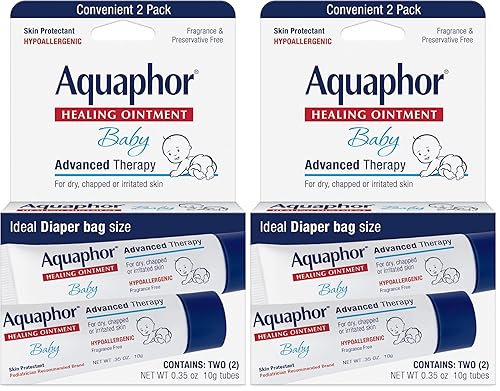
Aquaphor Baby Healing Ointment
If you could only put one skincare product in a baby's nursery, Aquaphor Baby Healing Ointment would be the correct choice. The petrolatum-based ointment is used for diaper rash prevention and treatment, dry and cracked skin anywhere on the body, chapped lips and cheeks, minor skin irritation, and the 'soak and seal' technique for eczema management. It is fragrance-free, dye-free, preservative-free, and trusted in NICUs for the most fragile premature infant skin. A single jar typically lasts two to three months of daily use. Dermatologists, pediatric nurses, and pediatricians collectively recommend it more than any other single baby skincare product.
- The most versatile single baby skincare product available
- Prevents and treats diaper rash effectively
- Petrolatum base creates the strongest moisture-sealing barrier
- NICU-trusted for premature and fragile infant skin
- Fragrance-free, dye-free, preservative-free
- Excellent cost per use
- Thick, greasy texture is not ideal for daytime face or body use
- May stain fabric
No single product solves more parenting problems than Aquaphor Baby. It handles the diaper area, the face, the body, and the scalp. It's the ointment a NICU nurse reaches for when a premature baby has skin too fragile for anything else. Its active ingredient — petrolatum — has been studied more extensively than any other topical occlusive and has a decades-long safety record in neonatal care.
Pros
- Solves more baby skincare problems per dollar than any other product
- NICU trusted — most validated baby skincare on the market
- Suitable from birth including premature newborns
- Every nursery needs at least one jar
Cons
- Greasy texture — best at night or under clothing
- May stain fabric if applied heavily
4. WaterWipes Original Baby Wipes — Must-Have for Diapering
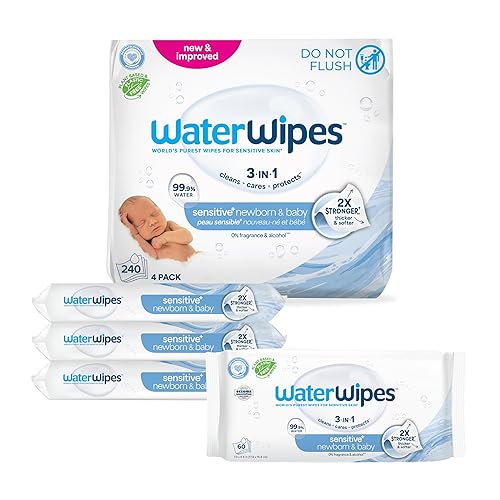
WaterWipes Original Baby Wipes
- Slightly higher cost per wipe than conventional alternatives
- Minimal ingredients means no cleansing soap — water and gentle extract only
The diaper area is wiped 8–12 times per day in the newborn period. Whatever ingredients are in that wipe are applied repeatedly to skin that is wet, warm, and in constant contact with potential irritants. The case for the simplest possible wipe is mathematically clear: with WaterWipes, there are two ingredients making that contact. With a conventional wipe, there may be fifteen or twenty.
Cons
- Higher per-unit cost — buy multipacks
- No cleansing agent means very soiled areas may need two wipes
5. Haakaa Silicone Breast Pump — Must-Have for Nursing Families
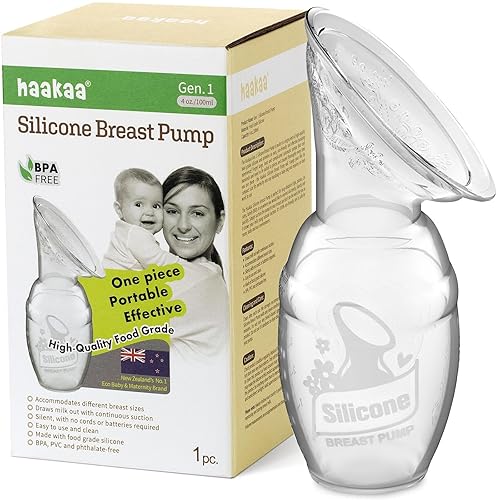
Haakaa Silicone Breast Pump
The Haakaa is a single-piece silicone cup that attaches to the breast opposite the one being nursed from, collecting the letdown reflex milk that would otherwise be lost into a nursing pad. No motor, no tubing, no electricity — it works by gentle suction created when you squeeze and attach. A breastfeeding parent who nurses 8–10 times per day can collect 0.5–2 oz per nursing session on the opposite side, adding up to 4–20 oz of extra milk per day with zero additional effort. For families building a freezer stash or managing oversupply, this is one of the most impactful and inexpensive baby products available.
- Collects letdown passively — no extra pumping sessions
- $13–16 price point for genuine milk supply impact
- One piece — easy to clean, nothing to assemble
- Silicone is food-safe, BPA-free, and dishwasher safe
- Can save significant milk that would otherwise be wasted
- Not a substitute for a double electric pump for building supply independently
- Some mothers find the suction causes mild overstimulation
- Requires careful placement — can spill if knocked
Lactation consultants often describe the Haakaa as one of the most underappreciated tools in a breastfeeding parent's kit. Many nursing parents don't realize how much milk is lost to the let-down on the side that isn't being nursed — it's absorbed by a nursing pad and discarded. The Haakaa catches it. Over days and weeks, this can represent dozens of ounces of frozen milk that cost no extra pumping time.
Pros
- Collect milk passively during every nursing session
- $13 price for outsized impact on milk supply
- One piece — simplest possible design and cleaning
- Favorite tool of lactation consultants
Cons
- Not an active pump — does not build supply independently
- Requires stable position — can spill if disturbed
- Not suitable for exclusively pumping parents
6. Dr. Brown's Original Baby Bottles — Must-Have for Bottle Feeding
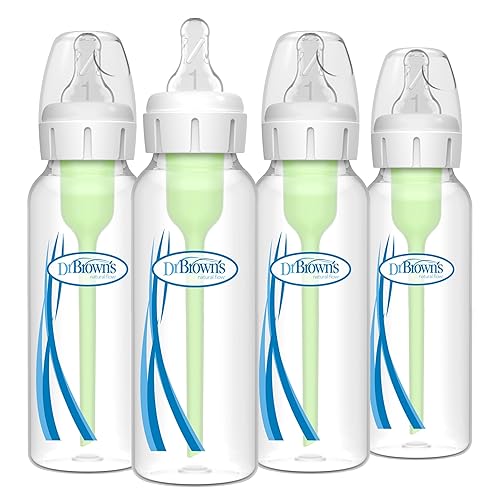
Dr. Brown's Original Baby Bottles
Dr. Brown's Original Bottles use a patented two-piece internal venting system that allows air to vent through the back of the bottle without passing through the milk. This eliminates the vacuum pressure that causes conventional bottles to collapse, and more importantly, it prevents the air bubbles that babies swallow during feeding — the primary cause of colic-related gas and fussiness. Pediatricians and lactation consultants have recommended Dr. Brown's as the first bottle to try for gassy, colicky, or uncomfortable babies for over 25 years. BPA-free, compatible with most breast pump flanges, available in 4 oz (newborn) and 8 oz (older baby) sizes.
- Internal vent prevents air ingestion — the root cause of feeding-related gas
- 25+ year pediatrician recommendation track record
- Compatible with most breast pump flanges
- Available in newborn (4 oz) and older (8 oz) sizes
- BPA-free
- Widely available in stores and online
- Internal vent adds two parts to wash — more cleaning than simple bottles
- Vent must be correctly positioned or loses anti-colic benefit
- Not spill-proof — must be kept upright
Colic-related gas and fussiness is one of the most exhausting challenges of early parenthood. Many cases have a mechanical cause: conventional bottle designs create a vacuum as milk is drawn out, causing the nipple to collapse and the baby to swallow air with each suck. Dr. Brown's internal vent eliminates this mechanism entirely, and the clinical evidence supporting it is substantial. If your baby is gassy, uncomfortable after feeds, or frequently fussy, this is the first thing to change before more complex interventions.
Pros
- Strongest evidence base for reducing feeding-related gas and colic
- 25+ year pediatrician recommendation
- Pump-compatible for seamless expressed milk feeding
- Newborn and older-baby sizes available
Cons
- Two-part vent requires thorough cleaning to prevent bacterial buildup
- More parts to lose than simple bottle designs
7. Frida Baby NoseFrida Snotsucker — Must-Have Health Tool
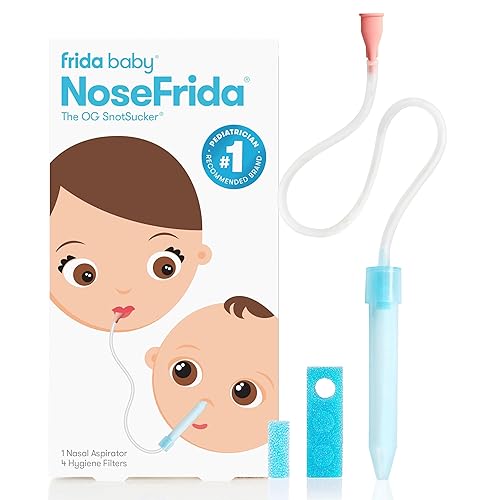
Frida Baby NoseFrida The Snotsucker Nasal Aspirator
Babies cannot blow their noses. When nasal congestion interferes with breathing, feeding, or sleep — and it will, multiple times in the first year — the NoseFrida is the most effective tool available. A parent creates gentle suction through a tube attached to a soft silicone tip that seals around baby's nostril (not inside it); a hygienic filter prevents any mucus from reaching the parent's end. It sounds alarming before you use it; parents who have a genuinely congested baby stop caring about the concept immediately and are grateful the product exists. Recommended by pediatricians and ENT specialists nationwide. Reusable with replaceable filters.
- Most effective nasal clearance method for infants who cannot blow their noses
- Soft silicone tip seals around nostril — not inserted inside
- Hygienic filter protects parent
- Pediatrician and ENT recommended
- Reusable with inexpensive replacement filters
- Concept is off-putting before you use it
- Requires replacement filters (available in multipacks)
- Some babies strongly dislike the process despite its effectiveness
Newborns are obligate nose-breathers — they cannot switch to mouth breathing when congested, which means nasal congestion directly impairs their ability to feed and sleep. The NoseFrida is the tool every pediatric office recommends because it works: it clears blockages that bulb syringes cannot reach, and it does so without inserting anything into the nasal cavity. The first time your baby has a cold and can suddenly breathe clearly, the product earns its place in the nursery permanently.
Pros
- Most effective congestion clearance for obligate nose-breathing newborns
- Non-invasive tip design safer than deep-insertion aspirators
- Filter maintains hygiene
- Pediatrician standard recommendation
Cons
- Requires replacement filters regularly
- Baby's resistance makes it a two-person job when they're older
- Takes adjustment for first-time users
8. HATCH Baby Rest Sound Machine — Must-Have Sleep Tool
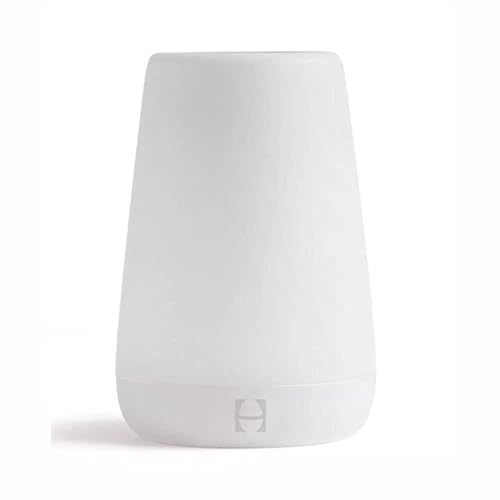
HATCH Baby Rest Sound Machine and Night Light
The HATCH Baby Rest combines a white noise machine, nightlight, and time-to-rise clock in one app-controlled device that grows with your child from newborn through school age. For newborns, white noise mimics the sound environment of the womb and is one of the most consistently effective sleep environment tools recommended by pediatric sleep specialists. The HATCH allows infinite customization of sound type, volume, and light color — all controllable from a phone without entering the baby's room. As children grow, it can be programmed to turn green when it's okay to get out of bed, eliminating the 5 a.m. 'is it morning?' visits for years.
- White noise is the most evidence-backed newborn sleep environment tool
- App-controlled — adjust without entering baby's room
- Grows from newborn white noise to toddler/child time-to-rise clock
- Night light customization for nighttime feeds without full lights
- Single device covers multiple sleep functions for years
- App dependency — requires smartphone and WiFi; device less useful without app
- Higher price than a simple white noise machine
- App occasionally has connectivity issues
White noise works by masking the sudden sounds that cause startle responses in sleeping newborns — a door closing, a dog barking, a sibling's voice. The AAP recommends keeping white noise at a safe distance (not directly in the crib) and at a volume below 50 dB. The HATCH allows precise volume control to stay within these guidelines.
The investment in the HATCH over a basic white noise machine is justified by its longevity: most parents report using it through age 5–7 and often longer for the time-to-rise clock function that reduces early morning disruptions.
Pros
- White noise — most evidence-backed newborn sleep tool
- App control means no room entry to adjust volume
- Grows from newborn through school age
- Time-to-rise clock prevents early morning wake-ups for years
- Night light for feeds without full brightness
Cons
- Requires app and WiFi to use full features
- Premium price over basic white noise machines
- Some users report occasional app connectivity issues
9. Ergobaby Embrace Newborn Carrier — Must-Have Carrier
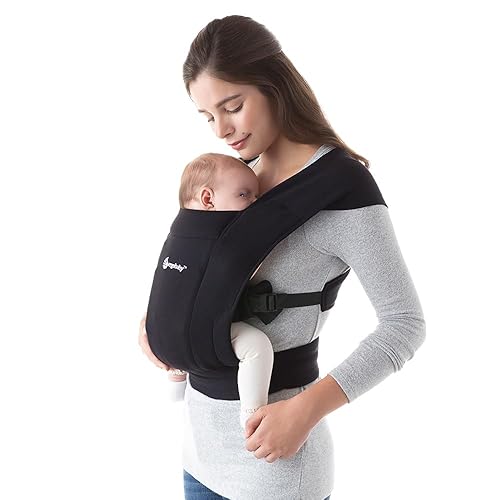
Ergobaby Embrace Soft Newborn Baby Carrier
Babywearing — keeping baby in a carrier against the parent's body — is one of the most effective ways to soothe a fussy newborn while keeping hands free. The Ergobaby Embrace is specifically designed for the newborn phase (7–25 lbs), with a pre-tied design that requires no instruction manual every use, a soft stretch fabric that distributes baby's weight across the parent's back and shoulders, and a wide padded seat that keeps baby's hips in the 'M position' recommended by the International Hip Dysplasia Institute. The carrier is machine washable, supports both inward-facing carry for newborns and outward-facing as baby grows, and is compatible with parents of most body types.
- No-instructions-needed pre-tied design
- Wide padded seat supports M-position hip development
- 7–25 lb range covers the newborn through early infant period
- Machine washable
- International Hip Dysplasia Institute recognized design
- Hands-free soothing frees parent for other tasks
- Limited weight range (to 25 lbs) — transition to structured carrier needed for older babies
- Stretch fabric can feel warm in summer
- Learning curve to position baby correctly for first few uses
The evidence for babywearing and infant soothing is compelling: contact with a caregiver's body regulates a newborn's temperature, heart rate, and cortisol levels. Babies who are carried cry less. The practical benefit for parents — having two free hands while keeping a fussy baby calm — is equally significant during the intense newborn period when simply existing feels like a full-time job.
The Embrace's pre-tied design is its key advantage over wrap-style carriers: there's no elaborate wrapping process with 5 yards of fabric. Put it on, put the baby in, done. This makes it realistic to use alone, repeatedly, in a parking lot or in your living room.
Pros
- Pre-tied design removes barrier of wrap carriers
- AAP-aligned hip positioning
- Hands-free soothing during fussy newborn period
- Machine washable
- Durable — outlasts the carrier phase and can be resold or gifted
Cons
- 25 lb limit — need a different carrier after ~9 months
- Warm to wear in summer months
- Getting baby in and out solo takes a few practice runs
10. Boppy Original Nursing Pillow — Must-Have Feeding Support
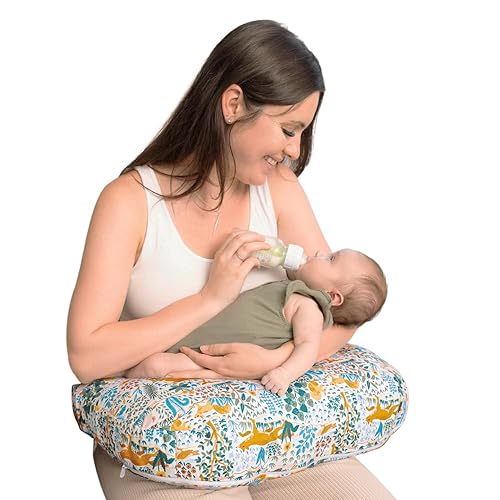
Boppy Original Nursing Pillow
The Boppy Nursing Pillow is a C-shaped pillow that wraps around the parent's waist, elevating the baby to breast or bottle height without requiring the arm to bear the baby's full weight. For nursing mothers recovering from childbirth, this arm and back support is not optional comfort — it's a genuine ergonomic necessity that affects whether feeds are manageable or painful for the parent. For bottle-feeding parents, it holds the baby at the correct angle without requiring a perfectly still held arm. Beyond feeding, the Boppy becomes a tummy time surface, a propping pillow when baby begins to sit, and a cushion throughout the first year. Covers are machine washable and sold separately.
- Arm and back support for nursing is a genuine comfort necessity
- Works for both nursing and bottle feeding
- Multipurpose: tummy time, propped sitting, lounging
- Machine-washable covers
- C-shape fits most body types
- Lasts the entire first year across multiple uses
- Covers sold separately (included cover is basic)
- Not appropriate for unsupervised baby positioning
- Firm insert wears over time with heavy use
The Boppy is the product that nursing mothers who struggled without one say they wish they'd had from day one. Holding a 7–10 lb baby at breast height with unsupported arms, 8–12 times per day, while also recovering from childbirth, is simply painful. The Boppy offloads that weight to the pillow resting on the parent's lap. It costs $40–50 and it makes hundreds of feeds significantly more comfortable.
Pros
- Genuine ergonomic relief for nursing recovery
- Works for bottle feeding too
- Multipurpose through entire first year
- Machine-washable covers
- Widely available everywhere
Cons
- Cover included is basic — buy a patterned cover separately
- Not for unsupervised baby placement
- Needs replacing if heavily compressed after 12+ months of daily use
What You Don't Need (But May Want)
These products are popular, well-reviewed, and genuinely useful — but they are not needs. Consider them want-list items rather than must-haves:
- Wipe warmer — nice in cold climates, not necessary; standard temperature wipes are fine.
- Bottle sterilizer — a pot of boiling water and 5 minutes achieves the same result; an electric sterilizer is a time-saver, not a safety necessity.
- Baby monitor (in small homes) — if you live in a one- or two-bedroom space, you will hear the baby without a monitor. In larger homes, a video monitor is genuinely useful.
- Diaper bag backpack — any large backpack works. Branded diaper bags are convenient but far from essential.
- Bouncer seat — incredibly useful but not everyone needs one. Borrow before buying if possible.
- Baby food maker — a blender does the same thing. A dedicated baby food maker is a convenience purchase.
Building Your Registry: A Prioritized Approach
Non-Negotiable Tier (Buy Before Baby Arrives)
- Car seat — you cannot leave the hospital without one
- Safe sleep surface — crib, bassinet, or Pack 'n Play
- Aquaphor Baby — apply from day one
- Diapers and wipes — in multiple sizes; newborn size is outgrown fast
- Feeding equipment — bottles if formula or expressed milk; Haakaa and Boppy if nursing
High-Value Tier (Buy in First Weeks)
- White noise machine (HATCH or similar)
- Nasal aspirator (NoseFrida) — you won't need it until the first cold, which arrives without notice
- Baby carrier
- Thermometer (rectal for newborns — the only accurate method)
Add as Needed (Based on Your Baby)
- Baby swing — invaluable for some babies, ignored by others
- Specialized bottles — if standard bottles cause gas issues
- Eczema products — if skin issues emerge
- High chair — not needed until 4–6 months
FAQ: Must-Have Baby Products
Final Verdict
The best registry is the one that prioritizes the products that will actually be used every single day — not the items that look impressive on a shelf or make you feel prepared in theory. Every product on this list gets used daily in the first three months, and most continue to be used for the entire first year.
If you're starting from scratch with a limited budget, the five-item core is: car seat, sleep surface, Aquaphor, WaterWipes, and the NoseFrida. Everything else is layered in from there based on your specific baby's needs. Trust the data: the products that parents buy, use, and tell other parents about are overwhelmingly the ones on this list — not the specialty gadgets that occupy shelf space and gather dust.