What changed in this May 2026 update: We re-validated every category against the latest AAP infant-care guidance and the active CPSC recall list. Updated examples to reflect current best-in-class products in each category. Next scheduled review: August 2026.
Affiliate Disclosure: As an Amazon Associate, we earn from qualifying purchases. This comes at no extra cost to you.
"Baby care products" covers everything from diaper rash cream to nasal aspirators — and most new parents have no idea which categories they actually need. This guide breaks down what each baby care category does, when you actually need it, and what to look for on the label.
The list of "baby products you need" that circulates on new parent forums is usually too long, too expensive, and full of things you'll use twice. This guide is different. It covers the products that address the actual recurring challenges of the first year — the care routines you'll perform every single day — organized by developmental stage so you buy what you need when you need it, not all at once.
We've organized this into three stages: the newborn window (0–3 months), the middle stretch (3–6 months), and the second half of the first year (6–12 months). Each stage introduces new challenges and new products that genuinely earn their place. Every product listed is something parents reach for regularly, not once.
Quick Comparison Table
| Product | Category | Best Stage | Use Frequency | Price Range |
|---|---|---|---|---|
| FridaBaby NoseFrida | Nasal Care | 0–12 months | As needed (frequent) | $ |
| Braun ThermoScan 7 | Temperature | 0–36 months | As needed | $$$ |
| FridaBaby NailFrida | Nail Care | Birth onward | Weekly | $ |
| WaterWipes | Diapering | 0–12 months | Daily (multiple times) | $$ |
| Aquaphor Baby | Skin Barrier | 0–12 months | Daily | $ |
| Wellements Gripe Water | Gas/Colic | 0–6 months | As needed | $ |
| Safety 1st Forehead Thermometer | Temperature | 0–36 months | As needed | $ |
| Desitin Maximum Strength | Diaper Rash | 0–24 months | As needed | $ |
Stage 1: Newborn Essentials (0–3 Months)
1. FridaBaby NoseFrida Snot Sucker — Best Nasal Aspirator
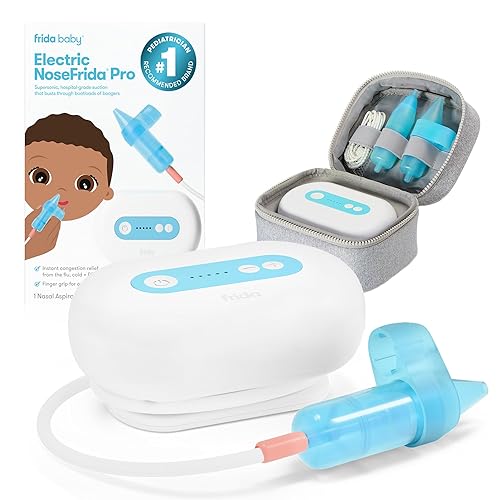
FridaBaby NoseFrida The Snotsucker Nasal Aspirator
Newborns breathe exclusively through their nose for the first few months. A stuffy nose — from a cold, dry air, or normal mucus accumulation — makes feeding difficult and disrupts sleep. The NoseFrida is a nasal aspirator that uses a tube and mouthpiece to allow a parent to apply controlled suction to clear baby's nasal passages. The suction passes through a filter that prevents mucus from reaching the parent's mouth — it is more effective than bulb syringes and significantly more controllable than electric aspirators. Endorsed by pediatricians across North America. Works with saline nasal drops (applied first to loosen mucus) for maximum effectiveness. Filters are replaceable. Dishwasher safe.
- More effective than bulb syringes — controlled, consistent suction
- Filter prevents any contact with mucus
- Works with saline drops for thorough clearing
- Dishwasher safe for easy sterilization
- Pediatrician-recommended across North America
- Replacement filters available
- Requires physical contact with a sick baby's face — some parents find this uncomfortable at first
- Regular filter replacement is an ongoing cost
- Not suitable for babies with bleeding disorders or other contraindicated conditions — check with pediatrician
The NoseFrida is one of those products that parents resist until they use it and then wonder how they managed without it. Stuffy-nose nights are among the most exhausting events of the newborn period — a baby who cannot breathe through their nose cannot latch for feeding, cannot sleep without waking, and cannot be soothed by normal means. The NoseFrida clears the blockage in seconds. The filter is effective and the suction is controlled — you cannot apply too much, because you are the suction source.
Use with saline drops: apply 1–2 drops of sterile saline to each nostril, wait 30 seconds, then apply the NoseFrida. The saline loosens dried or thick mucus significantly, making the aspiration more thorough. Little Remedies and Simply Saline make appropriate baby saline drops.
Pros
- Most effective consumer nasal aspirator available
- Controlled suction — more effective than bulb syringe
- Pediatrician-endorsed and widely recommended in hospital discharge paperwork
Cons
- Requires parent comfort with the mouthpiece concept
- Filter replacement is an ongoing purchase
2. Braun ThermoScan 7 Ear Thermometer — Best Thermometer
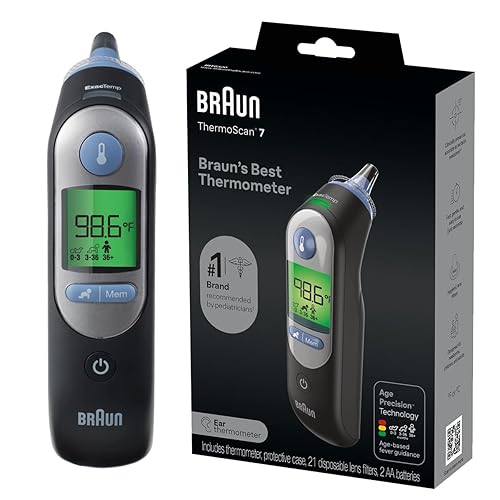
Braun ThermoScan 7 Digital Ear Thermometer
The Braun ThermoScan 7 is the thermometer that emergency departments and pediatricians' offices use. It takes a reading in one second from the ear canal, displays the temperature digitally, and stores the last nine readings for trend tracking. The Age Precision feature color-codes the reading (green/yellow/red) based on the child's age and the clinical fever threshold for that age group — a genuinely useful feature at 3am when you cannot remember whether 100.4°F is a fever for a two-month-old. Comes with disposable lens filter covers, which are required for accuracy and hygiene between uses — replacement packs are available separately. Battery included.
- One-second reading — no holding still required
- Color-coded Age Precision display shows fever severity by age
- 9-reading memory for trend tracking
- Hospital-grade accuracy in a consumer product
- Pre-warmed tip reduces reading error from cold probe
- Disposable filter covers maintain hygiene
- $55 — most expensive thermometer on this list
- Requires disposable filter covers — ongoing supply cost
- Ear canal positioning requires brief practice for accurate readings
- Not recommended for use in children under 3 months (rectal thermometer is more accurate for newborns)
The Age Precision feature is worth the price premium alone. Fever guidelines differ by age in ways that matter medically: a rectal temperature of 100.4°F in a baby under three months requires an immediate call to the pediatrician; the same temperature in a six-month-old is a watch-and-wait situation. The ThermoScan's color display removes the mental math of remembering which threshold applies at which age, which is valuable when you are exhausted and worried at 2am.
One note for newborns under three months: pediatricians recommend rectal temperature for this age group as the most accurate baseline. The ear thermometer is appropriate from three months onward. Many families use a simple digital rectal thermometer for the first three months and transition to the ThermoScan after that.
Pros
- One-second reading
- Age Precision color coding eliminates guesswork
- Hospital-grade accuracy
- 9-reading memory for tracking fever progression
Cons
- Most expensive thermometer on this list
- Requires disposable filter covers
- Ear canal method less accurate for babies under 3 months
3. FridaBaby NailFrida SnipperClipper Set — Best Baby Nail Care
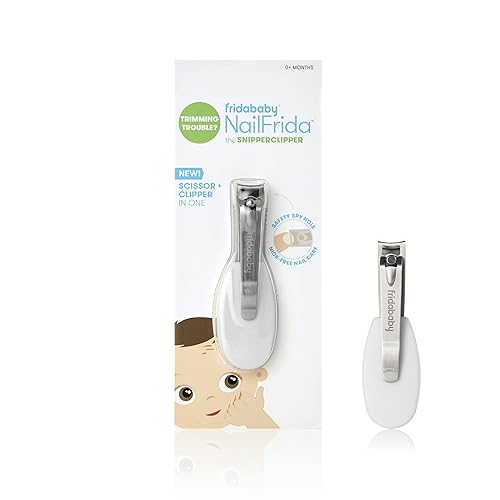
FridaBaby NailFrida The SnipperClipper Set
Newborn fingernails grow faster than most parents expect and are sharp enough to scratch the baby's own face within days of birth. The NailFrida SnipperClipper Set includes a small clipper with a spy-hole viewing window built into the blade guard — so you can see exactly where the blade is relative to the nail and skin before cutting. This eliminates the guesswork that makes standard baby nail clippers anxiety-inducing. The set also includes a nail file for gentle smoothing and a peep-hole cover. Designed specifically for the tiny, soft nails of newborns and infants. A nail file alone is often sufficient for the first few weeks before nails harden enough to require clipping.
- Spy-hole viewing window shows blade position before cutting
- Designed for newborn nail size — safe and precise
- File included for initial weeks when nails are too soft to clip
- Reduces nail-trimming anxiety significantly
- Compact and lightweight — easy to use one-handed
- Spy-hole window requires good lighting to use effectively
- For some babies, filing while sleeping remains easier than any clipping tool
- Replacement blades not available — eventual replacement of full unit
Baby nail trimming is one of the tasks that strikes the most fear into new parents. The nails are tiny, the baby moves, and the consequences of a slip — cutting into the fingertip pad — are minor but distressing. The NailFrida's spy-hole window solves the core problem: you can see exactly where the blade is before you close it. Most parents find the first few trims easiest by filing (not clipping) while the baby sleeps, then transitioning to clipping as the nails harden around 4–6 weeks.
Pros
- Spy-hole viewing window prevents accidental skin cuts
- Designed for newborn nail scale
- File included for the earliest weeks
Cons
- Good lighting required to use spy-hole effectively
- Some parents prefer filing during sleep regardless of tool quality
4. WaterWipes Plastic-Free Baby Wipes — Best Baby Wipes
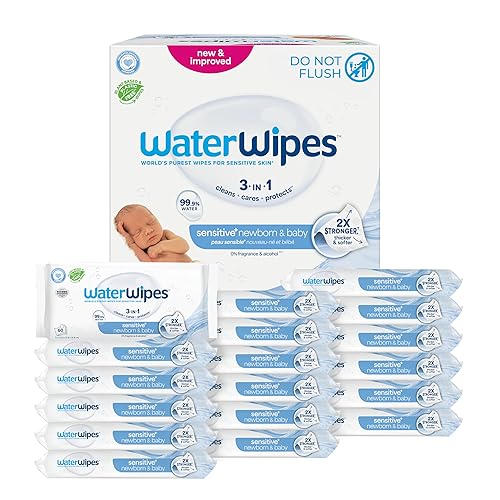
WaterWipes Plastic-Free Baby Wipes
WaterWipes contain two ingredients: 99.9% purified water and a trace amount of fruit extract as a preservative. That is the complete ingredient list. For comparison, most mainstream baby wipes contain 15–30 ingredients including preservatives, fragrances, thickeners, and pH adjusters, any of which can irritate the especially permeable skin of a newborn. Dermatologist-tested and clinically proven to be suitable for premature and sensitive skin, WaterWipes are the wipe recommended by neonatal units and pediatric dermatologists. Plastic-free version uses plant-based cloths. Available in bulk subscription packs. Slightly more expensive per wipe than mainstream alternatives, but the per-change cost difference is minimal — typically $0.01–0.02 per diaper change.
- Two ingredients: purified water + fruit extract only
- Dermatologist-tested, suitable for premature skin
- Plastic-free plant-based cloth
- Recommended by neonatal units
- Eliminates fragrance and preservative exposure during diaper changes
- Available in bulk packs for cost efficiency
- More expensive per wipe than mainstream brands
- Can feel wetter than thicker conventional wipes — some parents prefer more texture
- Subscription required for best per-unit pricing
- Not flushable
Newborn skin has a thinner, more permeable barrier than adult or older infant skin. The stratum corneum — the outermost protective layer — is not fully developed at birth and reaches adult-comparable thickness gradually over the first year. This means ingredients in wipes have greater skin penetration in the newborn period than they will later. Using a wipe that is essentially just water eliminates this exposure entirely during the most vulnerable window.
The two-ingredient formula also makes WaterWipes the default recommendation for any baby with eczema, contact dermatitis, or sensitivity reactions to standard wipes. Many parents switch to WaterWipes after a sensitivity reaction and never switch back.
Pros
- Two ingredients — simplest wipe available
- Neonatal unit recommended
- Suitable for eczema and sensitive skin
- Plastic-free formulation
Cons
- More expensive than mainstream wipes
- Wetter feel than thicker conventional alternatives
5. Aquaphor Baby Healing Ointment — Best Multi-Use Skin Product
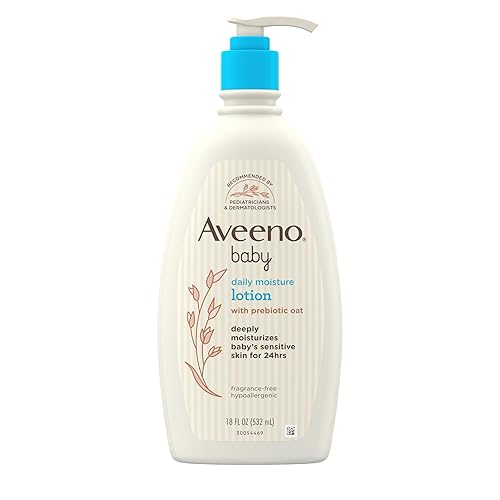
Aquaphor Baby Healing Ointment
Aquaphor Baby Healing Ointment is a petrolatum-based occlusive barrier that protects and heals irritated, cracked, or chapped baby skin. It is used for diaper rash prevention and treatment, dry skin patches, chapped lips, wind-burned cheeks, and any skin irritation from friction or exposure. Pediatrician-recommended, fragrance-free, and preservative-free. The thick ointment formula creates a protective barrier over the skin surface that locks in moisture and protects from further irritation while healing occurs underneath. A single tube lasts months in typical use. The 14 oz jar is the best value for families who use it regularly.
- Pediatrician-recommended and fragrance-free
- Works for diaper rash, dry skin, chapped lips, and general irritation — one product for multiple uses
- Petrolatum base is one of the most studied and proven skin barrier ingredients
- Very long lasting — small amounts are effective
- Can be used from birth without age restriction
- Inexpensive per use
- Thick petrolatum formula is greasy and transfers to clothing
- Not suitable as a daily moisturizer — best as a targeted barrier product
- Some parents prefer non-petrolatum alternatives for philosophical reasons (though petrolatum is safe and effective)
Aquaphor is one of the few baby care products that genuinely earns the label "essential." Its uses are broad enough that almost every parent reaches for it multiple times per week: the diaper rash that appears overnight, the chapped winter cheeks after a stroller walk, the dry patch behind the ear, the healing circumcision site, the peeling skin of the first two weeks. One product covers all of these.
The large 14 oz jar is the best value for regular users — the per-ounce cost is significantly lower than the smaller tubes, and the wide-mouth jar makes application easier. Keep a small tube in the diaper bag and the large jar at the changing table.
Pros
- Pediatrician-recommended, fragrance-free
- Multi-use: diaper rash, dry skin, chapped lips, irritation
- Proven petrolatum barrier formula
- One of the most cost-effective skin products available
Cons
- Greasy texture transfers to fabric
- Not designed as a daily full-body moisturizer
Stage 2: Middle Stretch (3–6 Months)
6. Wellements Organic Gripe Water — Best for Gas and Colic
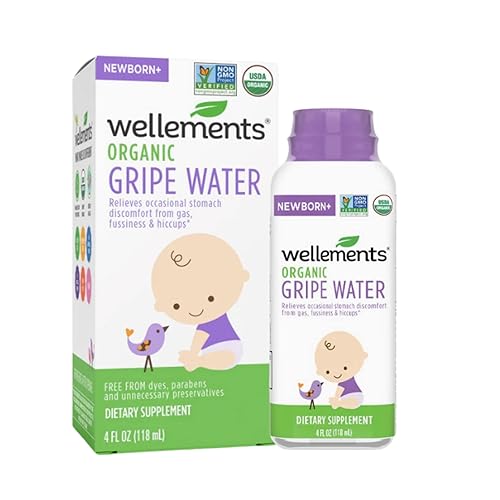
Wellements Organic Gripe Water for Tummy
Wellements Organic Gripe Water is an herbal supplement for infant gas, colic, stomach upset, and hiccups. The formula contains organic ginger root and organic fennel seed in a base of purified water — no alcohol, no sodium bicarbonate, no artificial colors or flavors, and USDA Certified Organic. Ginger and fennel have traditional and limited clinical evidence for reducing infant gastrointestinal discomfort. Administered via the included syringe, up to 5ml per dose, up to 6 times daily. Appropriate from 2 weeks of age. Works best administered 30 minutes before a feed for gas-prone babies, or at the onset of a fussing episode.
- USDA Certified Organic — ginger and fennel only
- No alcohol, no sodium bicarbonate, no artificial additives
- Appropriate from 2 weeks of age
- Syringe included for accurate dosing
- Works for gas, colic, hiccups, and general stomach upset
- Strong user reviews for gas and fussing reduction
Gas and colic affect an estimated 10–40% of infants in the first three months, peaking around 6 weeks and typically resolving by 3–4 months. During this window, gripe water is one of the most commonly tried interventions — alongside formula changes, feeding position adjustments, and winding technique. The clinical evidence for gripe water is limited but not absent: a 2019 randomized trial found fennel extract reduced colic crying duration significantly vs. placebo. Wellements is among the cleanest formulations available — no alcohol (which is sedating and inappropriate for infants), no sodium bicarbonate (which can affect acid balance), no artificial ingredients.
Pros
- USDA Certified Organic, alcohol-free, no artificial additives
- One of the cleanest gripe water formulations available
- Works for gas, colic, and hiccups
Cons
- Limited clinical evidence base
- Effects vary widely between babies
- Requires refrigeration and use within 30 days of opening
7. Safety 1st Easy Read Forehead Thermometer — Best Budget Thermometer
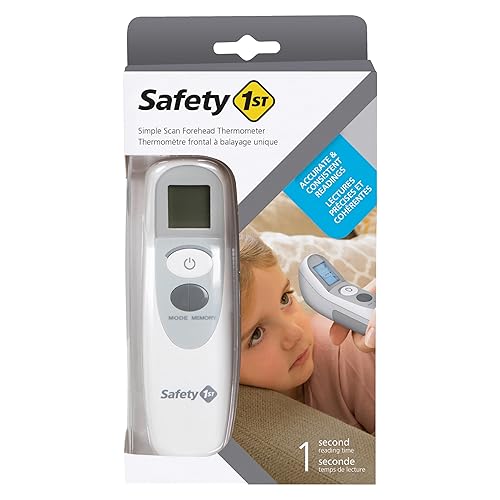
Safety 1st Easy Read Forehead Thermometer
The Safety 1st Easy Read Forehead Thermometer provides a non-contact temperature reading by scanning the forehead from 1–5cm distance, displaying the result in under two seconds on a backlit screen. The backlit display is readable in a dark nursery without turning on a light. While less accurate than the Braun ear thermometer for clinical-precision readings, it is accurate within ±0.4°F for typical use — sufficient for determining whether a child has a fever and monitoring trend over time. Battery included. The non-contact design means no waking a sleeping baby to check temperature. Best used as a quick-check tool, with a digital rectal thermometer for confirmation when precision is clinically important.
- Non-contact — no waking a sleeping baby
- Backlit display readable in dark nursery
- Two-second reading
- Under $20
- Good for trend monitoring and quick checks
- ±0.4°F accuracy — less precise than ear or rectal methods
- Non-contact readings more affected by room temperature and skin surface conditions
- Not recommended as the sole thermometer for medically vulnerable infants
Many families use both thermometers: the Safety 1st forehead unit for quick nighttime checks and trend monitoring without disturbing sleep, and a more accurate rectal or ear thermometer for confirmation when a fever reading requires a clinical decision. At $18, the Safety 1st is affordable enough to have in the diaper bag alongside a more accurate unit at home.
Pros
- Non-contact — doesn't disturb sleeping baby
- Backlit display for dark-room use
- Under $20
Cons
- Less accurate than ear or rectal methods
- Better as a quick-check than clinical confirmation tool
Stage 3: Second Half of the First Year (6–12 Months)
8. Desitin Maximum Strength Diaper Rash Cream — Best Diaper Rash Treatment
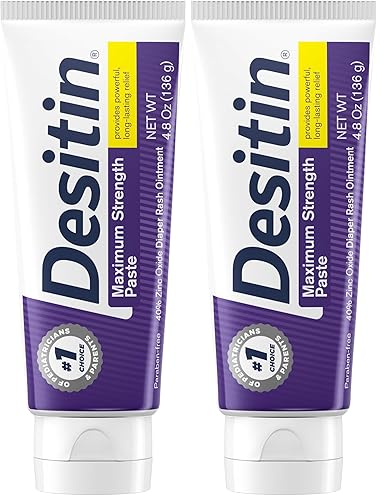
Desitin Maximum Strength Baby Diaper Rash Cream
Desitin Maximum Strength contains 40% zinc oxide — the highest concentration available in an OTC diaper rash product and the standard that pediatric dermatologists use as a benchmark for rash treatment efficacy. Zinc oxide creates a physical barrier between baby's skin and moisture/irritants while delivering anti-inflammatory and mild antimicrobial effects. Desitin Maximum Strength is the first recommendation from most pediatricians for an established diaper rash (as opposed to prevention, for which a lighter barrier cream or Aquaphor is used). Fragrance-free formula. The thick white paste formula is intentionally difficult to wipe off — you should leave a layer at each change rather than cleaning it all off, which prevents further skin stripping.
- 40% zinc oxide — maximum therapeutic concentration
- Pediatrician first recommendation for established rash
- Fragrance-free
- Barrier layer should be left at each diaper change — designed to stay on
- Wide availability at all major retailers
- Strong user track record for rash clearance within 24–48 hours
- Thick white paste — difficult to spread and stains fabric permanently
- Not for prevention — Aquaphor or lighter barrier cream is better for daily protection
- Does not treat fungal (yeast) diaper rash — requires antifungal treatment for that
Diaper rash affects nearly all babies at some point in the first two years — the combination of moisture, friction, and microbial exposure in the diaper area is the cause, and it intensifies during teething, antibiotic use, and dietary changes. Desitin Maximum Strength is the standard treatment: apply a thick layer at every diaper change until the rash clears, typically within 24–48 hours for a straightforward contact rash.
If a rash does not improve with zinc oxide cream within 72 hours, or if it has a distinct border with satellite spots, it is likely a yeast (Candida) infection and requires an antifungal treatment — Lotrimin AF or a prescription nystatin — which zinc oxide cream will not address. A call to your pediatrician at the 72-hour mark of a non-improving rash is always appropriate.
Pros
- 40% zinc oxide — most effective OTC concentration
- Pediatrician standard recommendation for rash treatment
- Clears typical contact rash within 24–48 hours
Cons
- Thick paste stains fabric
- For treatment only — use lighter barrier for daily prevention
- Does not treat yeast rash
Baby Care Products by Stage: Complete Checklist
0–3 Months (Newborn Essentials)
- ✅ Nasal aspirator (NoseFrida)
- ✅ Accurate thermometer (Braun ThermoScan 7 or rectal digital)
- ✅ Nail file + clipper set (NailFrida)
- ✅ Gentle wipes (WaterWipes)
- ✅ Skin barrier ointment (Aquaphor Baby)
- ✅ Saline nasal drops (Little Remedies or Simply Saline)
- ✅ Digital rectal thermometer for newborns under 3 months
- ✅ Baby wash and shampoo (Cetaphil Baby or Mustela Gentle Cleansing Gel)
3–6 Months
- ✅ Gripe water if gas/colic is an issue (Wellements Organic)
- ✅ Teething toys if early teething begins (typically 4–7 months)
- ✅ Sun protection for outdoor use (mineral SPF 30+)
- ✅ Diaper rash cream on hand (Desitin Maximum Strength)
- ✅ Baby carrier if not already using (Ergobaby Omni or Baby Björn Mini)
6–12 Months
- ✅ Baby toothbrush and toothpaste (Frida Baby SmileFrida or Baby Banana brush)
- ✅ Baby food maker if making homemade purees (BEABA Babycook)
- ✅ Sippy cup or straw cup for water introduction at 6 months (Munchkin 360 or Pura Stainless)
- ✅ Sunscreen — more important once baby is regularly outdoors (Badger Baby SPF 30)
- ✅ First aid kit update: add children's Tylenol and Motrin per pediatrician guidance
Frequently Asked Questions
Final Verdict
The core baby care kit for the newborn period is smaller than most lists suggest: the FridaBaby NoseFrida, Braun ThermoScan 7, NailFrida, WaterWipes, and Aquaphor Baby cover the overwhelming majority of daily care needs in the first three months. Add gripe water if colic emerges, Desitin for rash treatment, and stage-appropriate additions as your baby develops. Every other product is a convenience to evaluate based on your actual experience — not a registry recommendation from someone who doesn't know your baby.
Frequently asked questions (continued)
12 onesies, 8 sleepers, 4 swaddles, 200 diapers, baby wash, baby moisturizer, diaper cream, a thermometer, nasal aspirator, and a bassinet or crib. That's it for week 1. Everything else (bouncers, swings, playmats) can wait until you know what your baby actually likes. The AAP's First Year Checklist has a complete list.
Related reading from Your Happy Baby
- Must Have Baby Products
- Best Baby Products
- Best Baby Products For Newborns
- Best Baby Feeding Products