Affiliate Disclosure: As an Amazon Associate, we earn from qualifying purchases. This comes at no extra cost to you.
Last updated: May 2026 | Reviewed by Sarah Mitchell, former CPSC researcher
Baby led weaning (BLW) is the practice of letting babies feed themselves from the start of solids, rather than being spoon-fed purees. Instead of smooth, thin foods on a spoon, BLW babies are offered soft, appropriately-sized pieces of real food they can pick up and bring to their own mouths from around 6 months. The approach builds motor skills, develops food acceptance, and sidesteps the puree phase entirely.
The gear requirements for BLW are minimal compared to the purée route - no food processor, no freezer trays, no separate spoon sets. But what you do need must work well, because BLW is messier than spoon-feeding and a high chair or plate that does not stay put creates frustration that undermines the whole approach. This guide covers the eight BLW products worth buying, chosen for function over marketing.
BLW Readiness: When to Start
The American Academy of Pediatrics recommends starting solids around 6 months, when most babies show the developmental signs needed for BLW: sitting upright unsupported, loss of the tongue-thrust reflex (which pushes food out of the mouth), and showing interest in food. Earlier than 6 months is not recommended regardless of readiness signs. Always consult your pediatrician before starting solids.
BLW requires intact gag reflex (different from choking) and good head and trunk control. The gag reflex in babies is positioned further forward on the tongue than in adults - it is a protective mechanism, not a sign of danger. Learning to distinguish the gag reflex from choking is the most important first step before starting BLW.
Quick Comparison: Best Baby Led Weaning Products
| Product | Category | Best For | Price Range |
|---|---|---|---|
| Stokke Tripp Trapp | High chair | Long-term investment, grows to adult | $$$$ |
| Graco Blossom | High chair | Budget families, feature-rich | $$ |
| ezpz Mini Mat | Suction mat + plate | Babies who throw everything | $ |
| WeeSprout Suction Bowl | Bowl | Practicing scooping | $ |
| Bumkins Silicone Bib | Bib | Catching dropped food | $ |
| NumNum GOOtensil | Pre-spoon | First utensil at 6+ months | $ |
| Olababy Training Spoon | Spoon | Transitioning to self-feeding with spoon | $ |
| Munchkin Mesh Feeder | Mesh feeder | Teething, introducing new textures safely | $ |
The Most Important BLW Product: The High Chair
More than any plate or utensil, the high chair determines how well BLW works. For BLW to succeed, a baby needs to be positioned with hips at 90 degrees, feet supported (not dangling), and trunk upright. A baby slumped in a reclining seat, or with dangling feet, cannot engage their core muscles to reach for food effectively and is at higher aspiration risk. This rules out many standard high chairs with reclining positions and footrest-free designs.
Two positions to check before buying any high chair for BLW: does it sit upright (not recline)? Does it have a footrest at multiple height positions? If the answer to either is no, skip it.
Best High Chair Overall: Stokke Tripp Trapp

Stokke Tripp Trapp High Chair
The Stokke Tripp Trapp is the gold standard for BLW high chairs because it is one of the only chairs designed around the child's posture rather than parental convenience. Both the seat board and the footrest adjust on a rail system, allowing the chair to be configured for any child from 6 months (with the Tripp Trapp baby set, sold separately) through adulthood. The seat positions the hips at 90 degrees and the footrest supports both feet firmly - the two requirements for safe, effective self-feeding. The chair is made from solid beech wood with a 10-year warranty and holds up to 300 lbs, making it a true lifetime purchase. The minimalist design fits most dining tables. Baby set (required for infants under 9-12 months) includes a harness and raised guard rail and is sold separately on Amazon.
- Adjustable seat and footrest grow from 6 months to adulthood
- Positions baby correctly for safe self-feeding
- Solid beech wood — 300 lb weight limit, 10-year warranty
- No hard-to-clean fabric or padding to remove
- Fits flush to most dining tables
- Correct posture for optimal BLW engagement
- Baby set (required for infants) is sold separately, adding ~$50-70 to the cost
- $299 price point is the highest on this list
- Adjustment requires a screwdriver — not quick to reconfigure for multiple children
- Wood construction shows scratches over time
Best Budget High Chair: Graco Blossom 6-in-1

Graco Blossom 6-in-1 Convertible High Chair
The Graco Blossom is the most feature-complete high chair under $150, converting from an infant high chair to a toddler booster to a youth chair across six configurations. For BLW, the key features are the upright seating position (it does not recline during meal time), the multi-position footrest, and the deep-dish dishwasher-safe tray that catches dropped food before it hits the floor. The padded seat removes and wipes down easily, and the tray has a one-hand removal mechanism that matters when you are holding a baby with the other. At half the price of Stokke, it trades the lifetime construction and furniture-grade design for more features at a lower cost.
- 6-in-1 configuration grows from infant to youth chair
- Upright seating position suitable for BLW
- Multi-position adjustable footrest
- Deep dishwasher-safe tray — easy cleanup
- One-hand tray removal
- Less than half the price of premium alternatives
- Padded fabric seat requires more cleaning effort than a wood or easy-wipe surface
- Does not fit flush to most dining tables (tray extends outward)
- Heavier than Stokke — harder to move between rooms
- Plastic construction is not as durable long-term
Plates and Bowls: Keeping Food on the Table
BLW babies push, swipe, and throw food off every surface. Suction plates and mats that adhere to the table or high chair tray are a practical necessity - not a luxury. Standard plates slide and get thrown, which wastes food and creates safety risks on hard floors. Every plate on the BLW section of Amazon claims "strong suction"; two that actually deliver it are the ezpz Mini Mat and WeeSprout.
Best Suction Mat: ezpz Mini Mat
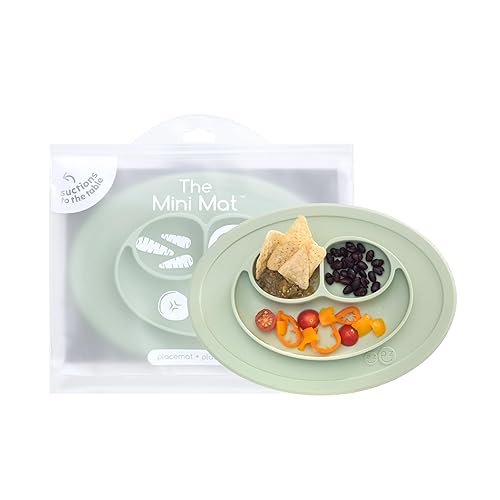
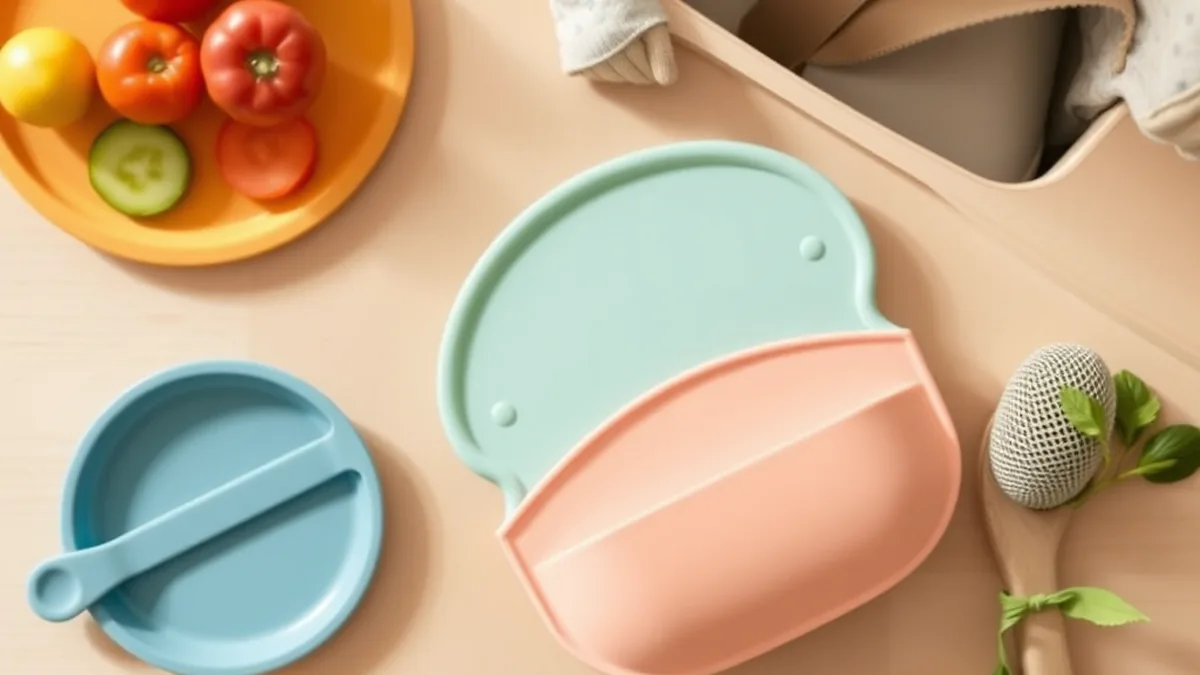
ezpz Mini Mat 1-Piece Silicone Placemat and Plate
The ezpz Mini Mat is a one-piece food-grade silicone mat and divided plate that suctions directly to smooth high chair trays and table surfaces. The one-piece design eliminates any rim that could be gripped and lifted - a key feature, because babies quickly learn to slide their hand under the edge of separate suction plates and pop them off. The mat is dishwasher safe (top rack), microwave safe, and BPA-free. The divided sections allow parents to offer multiple foods simultaneously without mixing - which matters for babies learning to identify and choose individual foods. The Mini size is appropriate for 6-18 month babies; the Happy Mat is the larger size for older toddlers.
- One-piece design — no edge to grip and lift
- Genuine suction holds on smooth surfaces
- Divided sections for offering multiple foods
- Dishwasher and microwave safe
- BPA-free food-grade silicone
- Mini size appropriate for 6-18 months
- Suction requires a smooth, clean surface — does not work on textured trays or fabric placemats
- Babies eventually learn to peel edges up from corners (usually around 12-15 months)
- Higher price than basic suction bowls
- Mini size may be too small for food-enthusiastic older babies
Best Suction Bowl: WeeSprout Silicone Suction Bowl

WeeSprout Silicone Suction Bowls for Baby and Toddler
WeeSprout's suction bowls use a wide-base suction ring that creates a stronger seal than narrow-bottomed alternatives, making them the most bowl-resistant-to-launch option for BLW. The food-grade silicone is flexible enough that babies can grip the sides comfortably for early scooping practice, and the round shape provides a consistent scooping surface for learning. Dishwasher safe top and bottom rack. BPA, BPS, and phthalate-free. Works on smooth high chair trays and countertop surfaces. Best introduced after 3-4 weeks of BLW practice, when babies have developed enough coordination to benefit from bowl use.
- Wide suction base provides stronger hold than narrow-bottomed bowls
- Flexible silicone walls comfortable for early gripping
- Round shape aids scooping practice
- Dishwasher safe — both racks
- BPA, BPS, and phthalate-free
- Good value at under $16
- Suction requires smooth surface — same limitation as all suction products
- Adventurous babies will eventually defeat any suction bowl
- Not ideal as the very first BLW plate (use a flat mat like ezpz to start)
Bibs: Catching What Gets Dropped
BLW is messy by design - babies explore food with their hands, their faces, and often their hair. A standard cloth bib is inadequate because it absorbs rather than catches. A silicone bib with a deep, rigid food-catching pocket turns cleanup from a full-outfit change into a quick wipe. One good silicone bib replaces a week's worth of cloth bibs in the laundry.
Best BLW Bib: Bumkins Silicone Bib

Bumkins Silicone Bib with Food Catching Pocket
The Bumkins Silicone Bib has a deep, structured food pocket that stays open during feeding and catches food pieces, liquid, and crumbs that would otherwise end up on the baby's lap, the high chair, or the floor. The pocket holds a significant amount before it needs emptying - enough to get through a full BLW meal without dumping. The bib rolls up for the diaper bag and wipes clean in seconds with a damp cloth, or goes in the dishwasher top rack. The adjustable neck snap fits 6 months through 3 years. Silicone does not absorb stains or odors from tomato sauce, turmeric, or berries the way cloth bibs do.
- Deep structured pocket stays open and catches dropped food
- Wipes clean in 10 seconds or dishwasher-safe
- Does not absorb stains or odors
- Rolls up compact for travel
- Adjustable neck fits 6 months to 3 years
- BPA-free food-grade silicone
- Rigid pocket can feel stiff against some babies' laps initially
- Neck fastener can be stiff at first — loosen it a few times before first use
- Not suitable for babies under 6 months (high chair age)
Utensils: First Tools for Self-Feeding
Most 6-month-old babies cannot scoop food with a spoon - the motor coordination for that develops between 9 and 14 months. BLW utensils for new starters are designed around what babies can actually do: dip, poke, and bring a flat or curved surface to their mouth. The pre-spoon and training spoon categories exist for this developmental window.
Best First Utensil: NumNum GOOtensil Pre-Spoon

NumNum Pre-Spoon GOOtensil Stage 1 and Stage 2 Set
The NumNum GOOtensil is a flat, disc-shaped pre-spoon that lets babies load food onto a textured surface by pressing down and lifting rather than scooping. The Stage 1 disc (for 6-9 months) is completely flat with texture channels; the Stage 2 (9-18 months) has a shallow bowl as coordination develops. The set comes with both stages. The short, chunky handle is sized for infant fist grip - standard spoon handles are too long for 6-month-old arm length. Food sticks to the textured surface so it reaches the baby's mouth more reliably than a flat spoon. Dishwasher safe, BPA-free, no sharp edges.
- Flat press-and-lift motion matches 6-month motor skills
- Stage 1 and Stage 2 in one set
- Short handle designed for infant fist grip
- Textured surface holds food better than flat spoons
- Dishwasher safe
- No sharp edges — fully safe for infant mouth exploration
- Babies move to Stage 2 utensils relatively quickly — the set's useful life is about 4-6 months per stage
- Not suitable as a standalone feeding tool — babies still need finger foods alongside
- Textured disc can be tricky to clean thoroughly by hand (dishwasher recommended)
Best Training Spoon: Olababy Silicone Training Spoon
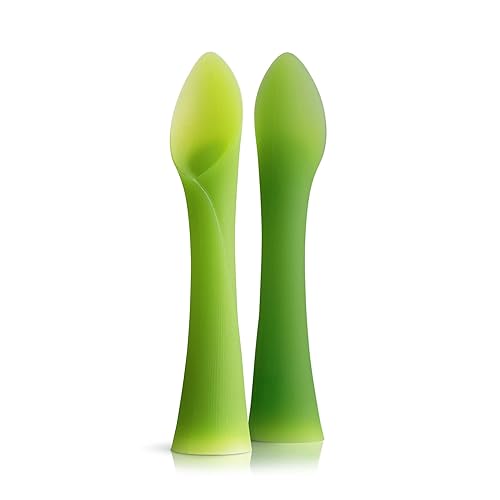
Olababy Silicone Training Spoon for Baby Led Weaning
The Olababy training spoon is designed for babies 6 months and up who are beginning to hold utensils. The soft, flexible tip is safe for tender gums and emerging teeth, and the bowl of the spoon is shallow enough to fit comfortably in an infant's mouth without triggering the gag reflex from depth. The ergonomic handle has a slight curve that matches the natural wrist angle of a baby reaching toward their mouth, reducing the wrist rotation required compared to a standard spoon. The short length is calibrated for arm-to-mouth distance at 6 months. Steam sterilizer safe, dishwasher safe, BPA-free.
- Soft flexible tip safe for gums and emerging teeth
- Shallow bowl appropriate for infant mouth depth
- Curved handle matches natural wrist angle
- Short length calibrated for 6-month arm reach
- Steam sterilizer and dishwasher safe
- BPA-free food-grade silicone
- Babies typically need parental help loading the spoon until around 12 months
- Soft tip may not provide enough resistance for babies who bite hard
- Only available in limited colors
Mesh Feeder: For Texture Introduction and Teething
Mesh feeders are not a core BLW tool - but they serve a specific purpose: letting babies who are not yet ready for full finger food pieces to experience new flavors and textures safely, or using frozen breast milk or cold fruit for teething pain. The mesh prevents any piece from being large enough to pose a choking risk.
Best Mesh Feeder: Munchkin Fresh Food Feeder
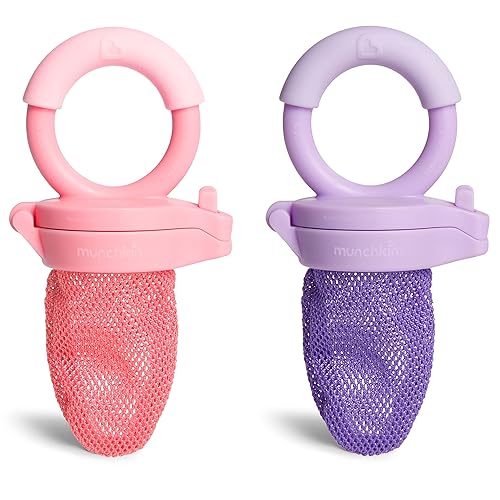
Munchkin Fresh Food Feeder for Baby Led Weaning
The Munchkin Fresh Food Feeder uses a fine mesh bag attached to a ring-and-handle that babies can grip and bring to their mouth independently. Load it with soft fruit, steamed vegetables, or frozen breast milk for safe texture exploration at 4-6 months before full BLW begins, or use it alongside BLW for teething pain relief. The mesh size prevents any piece from passing through that could cause choking, while allowing babies to experience real food flavors and textures. The handle is sized for infant grip. Hand-wash recommended (mesh can trap food in dishwasher). Replacement mesh bags are available on Amazon.
- Allows safe flavor and texture exploration before BLW readiness
- Excellent for teething pain with frozen fruit or breast milk
- Baby-sized handle for independent gripping
- Prevents any piece from being choking size
- Budget price at under $9
- Replacement mesh bags available
- Mesh requires careful hand washing to prevent food mold
- Not a substitute for actual finger food BLW practice
- Food cleanup inside the mesh is labor-intensive
- Mesh bags need replacing every 2-3 months with regular use
What You Do Not Need for BLW
The BLW product market is full of gadgets designed for parents who are anxious about the transition to solids. Save your money on these:
- Puree pouches and spoon sets - BLW skips the purée phase by design. If you are offering only finger foods, you do not need squeeze pouches.
- Fancy food processors - BLW food is soft-cooked whole food cut appropriately. A knife is the only tool needed.
- Suction cup sets of 8+ pieces - You will use 2-3 pieces at most. Start with one mat, one bowl.
- Bibs with pockets AND sleeves AND a cape - A single silicone pocket bib handles 90% of BLW cleanup. Sleeve bibs are for art projects, not daily feeding.
- Floor mats - Useful if you have carpet, unnecessary on hard floors where cleanup takes 30 seconds with a damp cloth.
Frequently Asked Questions
[faq_item question="What age should I start baby led weaning?" answer="The American Academy of Pediatrics recommends starting solids at around 6 months, when most babies show the developmental readiness signs for BLW: sitting upright unsupported without slouching, loss of the tongue-thrust reflex, and interest in food. Starting earlier than 6 months is not recommended regardless of other readiness signs. Always discuss the timing with your pediatrician before starting any solid food approach."]
[faq_item question="Is baby led weaning safe? What about choking?" answer="BLW has a strong safety record when started at the right age with appropriate food preparation. A 2016 study in the journal Pediatrics found no increased choking risk in BLW babies vs. spoon-fed babies. The key safety factors are: correctly prepared food (soft enough to squish between fingers, appropriate size and shape), correct high chair positioning (upright, not reclined, feet supported), and parental understanding of the difference between gagging (loud, protective) and choking (silent). Take an infant CPR and choking response course before starting BLW."]
[faq_item question="What foods should I start with for BLW?" answer="Start with soft-cooked vegetables cut into finger-shaped strips long enough to extend past the baby's fist: steamed broccoli florets, roasted sweet potato sticks, steamed carrot batons. Ripe fruit like banana and avocado can be offered with a strip of the skin left on for grip. Eggs (scrambled soft), well-cooked salmon flaked into large pieces, and soft toast strips are excellent protein sources. Avoid honey (botulism risk under 12 months), whole nuts, raw hard vegetables, round grapes, whole cherry tomatoes, and anything very sticky."]
[faq_item question="Do I need a special high chair for baby led weaning?" answer="Not a special BLW-only chair, but a chair that meets two requirements: upright seating (no recline during mealtimes) and a footrest at an adjustable height. Babies need foot support for core muscle engagement during self-feeding. Many standard high chairs recline, have no footrest, or have footrests fixed at one height. The Stokke Tripp Trapp and Graco Blossom both meet the BLW requirements. Avoid bouncer-style infant seats for BLW mealtimes."]
[faq_item question="What is the difference between BLW and traditional weaning?" answer="Traditional weaning introduces thin purees on a parent-held spoon, progressing to thicker textures over months. Baby led weaning skips the puree phase and offers age-appropriate soft pieces of real food that the baby picks up and feeds themselves from around 6 months. BLW is messier and requires more parental confidence about what the baby is eating vs. what ends up on the floor. Evidence suggests BLW may reduce fussy eating and overweight risk, though most studies show similar nutritional outcomes between approaches."]
[faq_item question="How do I know if a food piece is the right size for BLW?" answer="The finger food test: a piece should be about the size and shape of an adult finger - long enough to extend past the baby's fist when gripped (3-4 inches), and soft enough to squish easily between your thumb and index finger with light pressure. If you cannot squish it easily, it is too hard. Rounds (whole grapes, whole cherry tomatoes, hot dog rounds) are the highest choking-risk shapes - always cut them lengthwise. Anything smaller than a grape is too small for a new BLW starter because it requires pincer grip, which develops at 8-10 months."]
[faq_item question="Will my baby get enough nutrition from BLW if they are dropping most food on the floor?" answer="At 6-9 months, breast milk or formula remains the primary nutrition source - food is exploratory. Expect most of the food to end up on the floor, the bib, and the baby's face in the first 4-6 weeks. Intake increases gradually as motor skills improve. The AAP and WHO both note that solid food before 12 months is primarily about developing skills, not meeting caloric or nutritional needs. Keep offering milk feeds on the normal schedule and do not restrict them to increase food intake."]
[faq_item question="Can I do a mix of BLW and purees?" answer="Yes - this is sometimes called responsive feeding or combined weaning, and it is perfectly safe. Many families offer finger foods for self-feeding alongside spoon-fed purees when parents want to participate more actively in feeding. The only thing to avoid is loading a spoon and handing it to the baby - that pre-loaded spoon hand-off removes the self-feeding skill development that makes BLW effective. If you spoon-feed, keep it separate from the finger food BLW session."]
Related Reading
- Best Baby Feeding Products: Complete Guide from Bottles to High Chairs
- Graco Baby Products Review: High Chairs, Swings, and Bouncers
- Munchkin Baby Products Review: Cups, Utensils, and Bath Gear
Final Thoughts
The most important BLW products are the two that support correct positioning and reduce mess: a high chair with a proper footrest and upright position, and a silicone pocket bib. Everything else - the ezpz mat, the suction bowl, the pre-spoon - adds convenience and supports skill development but is secondary to those two fundamentals.
Start with a high chair, one silicone bib, and a few appropriate foods. Add the ezpz mat when you are ready to offer multiple foods. Add utensils when your baby shows interest in holding something at the table, usually around 8-9 months. The gear list grows naturally with the baby's skill level.
For more on what to feed and what to avoid, the AAP's Starting Solid Foods guide is the most current clinical resource. The Rapley Weaning website (from the researcher who coined the term BLW) covers the evidence base in detail.