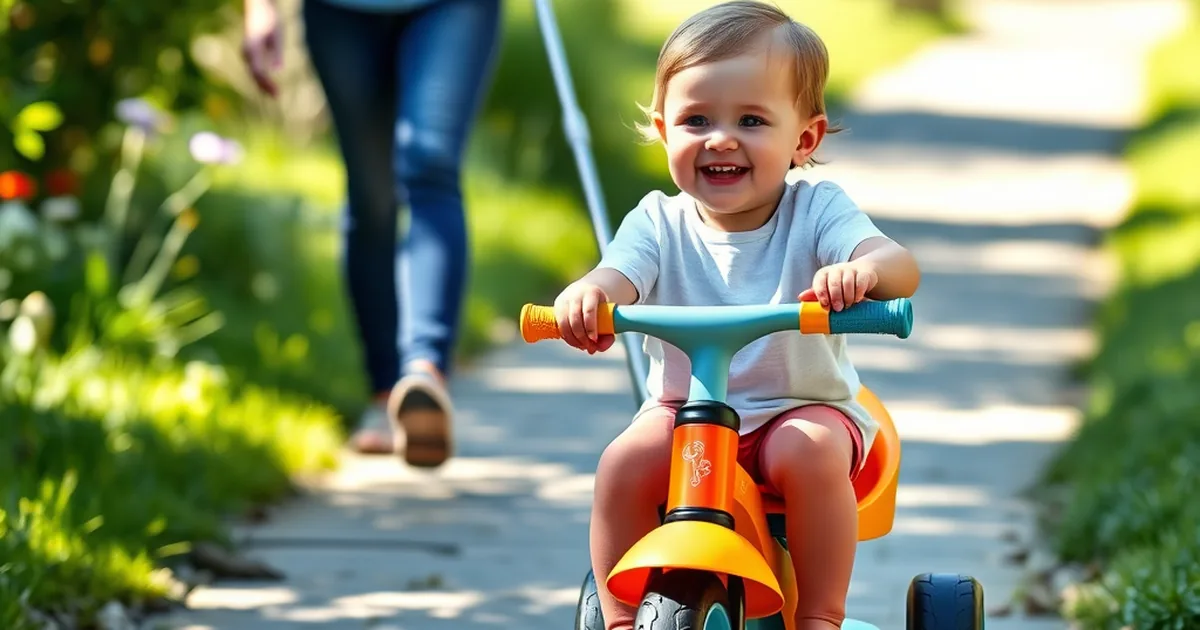
Toddler tricycles develop leg strength, pedaling coordination, and steering control for children from approximately 2 to 5 years. The best models offer parent push-bar capability for younger children who are not yet ready to self-propel, a footrest for passive riding, and construction quality that survives outdoor use across multiple seasons. Here are the four best toddler tricycles of 2026.
Radio Flyer 4-in-1 Stroll N Trike
The Radio Flyer 4-in-1 Stroll N Trike is the best tricycle on this list for the widest age range, converting through four configurations from a stroller-style push ride at 9 months to a fully independent pedal tricycle at 5 years. Radio Flyer is the most recognized American children's ride-on brand, with a history extending to 1917, and the 4-in-1 represents their most sophisticated current tricycle design with the parent-steered and child-pedaled stages integrated into one frame. The conversion between stages requires repositioning a few components and takes approximately 5 minutes each time.
Stage 1 (9-18 months) uses a full parent push bar and steering control, with the child seated in a bucket seat with a footrest and safety harness. Stage 2 (18-36 months) removes the harness, adds access to the pedals, and allows the child to pedal while the parent steers and controls the push bar. Stage 3 (3-5 years) removes the parent steering override and the push bar adjusts to a trailing arm, with the child controlling their own steering and pedaling. Stage 4 (4-5 years) removes the parent push bar entirely for fully independent riding.
The Radio Flyer 4-in-1 uses a steel frame with a powder-coat finish in red or blue. The front wheel is 10 inches and the rear wheels are 7 inches, providing stability proportional to the child's size at each stage. The seat has two height positions adjustable without tools. A storage basket under the seat holds small items for the ride. The folding parent push bar stows flat against the seat back for storage or transport in a car.
At $99.99, the Radio Flyer 4-in-1 is the best-value multi-stage tricycle on this list. The 9-month start age means parents can begin using it with a young infant in the stroller mode and transition through all four stages across 4-5 years of continuous use, making the per-year cost one of the lowest on this list.
Best for: Families who want a tricycle covering 9 months through 5 years in four configurations, with parent steering and push control in early stages.
Age range: 9 months to 5 years (4 configurations)
Frame: Steel with powder coat finish
Price: $99.99
Schwinn Roadster Kids Tricycle
The Schwinn Roadster is the best classic tricycle on this list for families who want a retro-styled ride-on that looks like a vintage toy rather than a modern plastic product. Schwinn is a cycling brand with a 130-year history, and the Roadster tricycle applies their heritage aesthetic to a toddler product: low-profile step-through frame, wide padded saddle, chrome handlebars with streamers, and a rear platform deck for small passengers or cargo. The Roadster evokes the American backyard childhood aesthetic that makes it popular as a birthday and holiday gift independent of its functional qualities.
The Roadster is a straightforward single-stage tricycle without parent push bar or multi-stage conversion. It is designed for children who are already ready to pedal independently, typically 2.5-5 years. The direct-drive pedaling uses the standard pedal-chain-to-rear-axle mechanism that most adults remember from childhood, though the Roadster uses a simpler direct-pedal-to-front-wheel design that eliminates the chain and sprocket complexity. The front wheel drives directly from the pedal crank, which means pedaling speed directly controls wheel speed - an intuitive relationship for early learners.
The steel frame construction provides solid durability. The rear platform deck is weight-rated for a small stuffed animal or lunch bag rather than an additional child. The adjustable seat covers approximately 18-24 inch inseam range. Available in classic red with chrome details. Weight capacity is 42 lb. The Roadster does not fold for transport and requires standard handlebar assembly at delivery.
At $79.99, the Schwinn Roadster is the most affordable full-steel tricycle on this list. For parents who want a classic, no-bells-and-whistles tricycle for a child 2.5-5 years who is ready to pedal independently, the Roadster provides the iconic design and solid construction of the Schwinn brand at an accessible price.
Best for: Families who want a classic retro-styled all-steel tricycle for children 2.5-5 years ready for independent pedaling, without multi-stage parent controls.
Age range: 2.5 to 5 years (single pedaling stage)
Design: Retro Schwinn heritage styling with chrome handlebars and streamers
Price: $79.99
Joovy Tricycoo 4.1 Tricycle
The Joovy Tricycoo 4.1 is the best tricycle on this list for families who need the simplicity of a single-bag transport solution. The Tricycoo folds in half at the frame's mid-point, reducing its length from 38 to 22 inches for storage in a car trunk or a closet. No other traditional trike on this list folds for transport, which makes the Joovy the most practical choice for families who take the tricycle to parks, grandparents' houses, or other locations where carrying a full-size trike is impractical.
The Tricycoo 4.1 includes a parent push bar and a steering lock that overrides the front wheel for full parent control in the earliest stage. As the child gains confidence, the steering lock releases and the child controls their own direction with the handlebars while the parent maintains push bar speed control. The final stage removes the push bar for independent riding. This three-stage transition mirrors the Radio Flyer 4-in-1's concept at a slightly older starting age (18 months vs. 9 months).
The aluminum frame keeps the overall weight at 12 lb, which is lighter than the steel-frame Radio Flyer and Schwinn alternatives. The seat includes a two-point safety belt for younger riders and adjusts to three height positions without tools. The included footrest accommodates passive passengers in the 18-24 month range who are not yet pedaling. The sun canopy is removable.
At $89.99, the Joovy Tricycoo 4.1 is priced between the Schwinn and the Radio Flyer. The folding frame is the distinguishing purchase reason: if transport between locations is a regular part of how the family uses the tricycle, the Joovy's fold makes it the only practical option regardless of the price comparison with non-folding alternatives.
Best for: Families who regularly transport the tricycle between locations and need a fold-flat frame that fits in a car trunk, at a price between the Schwinn and Radio Flyer.
Folding: Yes (folds to 22-inch length)
Frame: Aluminum (12 lb, lightest on this list)
Price: $89.99
SmarTrike Breeze Tricycle
The SmarTrike Breeze is the best-engineered single-purchase tricycle on this list, produced by a brand that specializes exclusively in the tricycle category and has refined their design over multiple product generations. SmarTrike's design philosophy centers on what they call "TouchSteering" - a mechanism that allows the parent push bar and the child's handlebars to operate simultaneously and independently, so a parent can provide directional guidance without the child losing the sensation of controlling their own steering. This dual-control system is more sophisticated than the simple lock/unlock approach on the Radio Flyer and Joovy.
The Breeze includes four configuration stages beginning at 15 months: parent-only steering with a bucket seat and canopy, shared steering with parent push bar, child-controlled steering with parent push, and fully independent pedaling. The TouchSteering mechanism is the feature that distinguishes this from other multi-stage trikes: the child's handlebar inputs are real (not locked out) at all stages, which means the child develops directional control from the very first rides rather than waiting until a lock is disengaged.
The seat has three height positions and a five-point harness for the youngest riders. The rear storage bag holds snacks, sunscreen, and a small toy. The canopy provides UV50+ coverage and removes for storage. The frame is high-density plastic over an aluminum tube backbone, which is lighter than full-steel alternatives and moisture-resistant for outdoor use in rain or wet grass.
At $79.99, the SmarTrike Breeze is priced alongside the Schwinn Roadster but covers a much wider age range (15 months to 4 years in four stages versus the Schwinn's single stage from 2.5 years). For families who want the multi-stage parent-control progression with the TouchSteering dual-control design, the SmarTrike provides comparable developmental value to the Radio Flyer 4-in-1 at a slightly lower price.
Best for: Parents who want dual-control TouchSteering that allows child-controlled handlebar input at all stages, covering 15 months to 4 years in four configurations.
Age range: 15 months to 4 years
Steering: TouchSteering (parent and child operate simultaneously)
Price: $79.99
How to Choose a Toddler Tricycle
When is a child ready for a tricycle?
Most children are developmentally ready to begin working toward pedaling between 18 and 24 months, though the majority do not develop reliable self-propulsion until 2.5-3 years. Multi-stage tricycles (Radio Flyer, SmarTrike, Joovy) accommodate the pre-pedaling phase with parent push control, making them appropriate earlier than single-stage models. A child who has mastered a balance bike (no pedals) typically transitions to pedaling faster than a child who has not, because the balance and weight-shift skills transfer directly to the tricycle's steering demands.
What is the difference between a parent push bar and a steering lock?
A parent push bar attaches to the rear of the tricycle and allows the parent to push and direct the trike from behind. A steering lock is a separate control that fixes the child's handlebar in the straight-forward position. Push bar plus steering lock means the parent has full speed and direction control with the child as a passive passenger. Push bar without steering lock allows the child to steer while the parent manages speed. SmarTrike's TouchSteering allows simultaneous independent inputs from both parent and child, which is the most developmentally sophisticated design.
Should you choose a plastic or steel frame tricycle?
Steel-frame tricycles (Schwinn Roadster, Radio Flyer 4-in-1) are heavier, more durable under impact, and have a premium feel. Aluminum and plastic-backbone trikes (SmarTrike, Joovy) are lighter, more moisture-resistant, and easier to carry. For outdoor use in wet climates, the moisture resistance of non-steel frames reduces rust risk at joints and hardware connections. For purely decorative gifting or dry-climate use, steel frames have a more premium appearance. Weight matters more than most parents anticipate: a 12-lb aluminum trike is significantly easier to carry to a park than an 18-lb steel trike.
Frequently Asked Questions
Can a 2-year-old ride a tricycle?
Most 2-year-olds can begin learning the pedaling motion on a tricycle, but many cannot sustain forward propulsion reliably until 2.5-3 years due to leg strength and coordination limitations. A multi-stage tricycle with a parent push bar allows a 2-year-old to participate in a tricycle ride (being pushed while attempting to pedal) before they can self-propel. The learning period for reliable self-propelled pedaling typically takes 1-3 months of regular sessions, shorter for children who have used balance bikes.
How do you teach a toddler to pedal?
Start with the tricycle on a flat surface and hold the seat steady while guiding the child's feet in the pedaling motion. Let the child feel the circular motion with manual guidance before expecting self-initiated pedaling. Some children understand the motion immediately from observation of others riding; most need 3-10 guided sessions. Tricycles with parent push bars allow the child to experience forward movement from their pedaling attempts even before the force they produce is sufficient to actually move the trike, which reinforces the cause-and-effect learning.
Are tricycles safer than balance bikes for toddlers?
Tricycles and balance bikes serve different purposes and the safety comparison depends on context. Tricycles are more stable at rest (three wheels do not fall over when the child stops pedaling) but are harder to maneuver and slower to learn. Balance bikes develop balance and steering skills faster for the progression to a standard bicycle. Tricycles do not teach balance and are not a prerequisite for learning to ride a pedal bike. Most developmental specialists now recommend balance bikes as a first ride-on for toddlers who will eventually transition to a pedal bicycle, reserving tricycles for children who want the pedaling experience before they have sufficient balance for a two-wheel format.