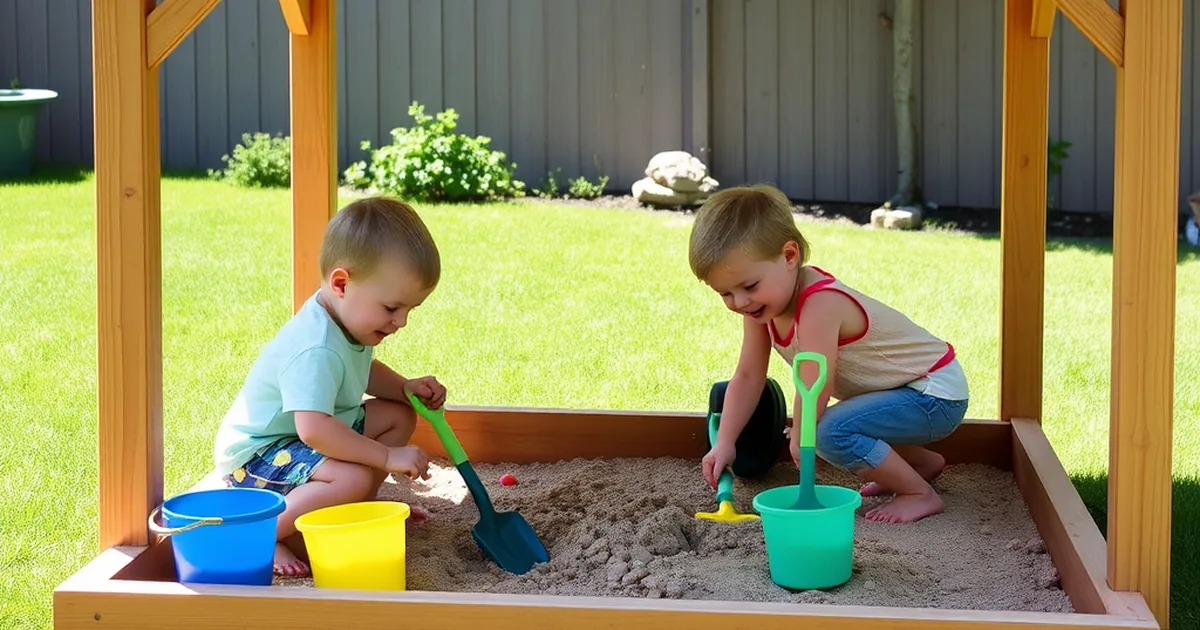
Toddler sandboxes give children a contained space for digging, pouring, and building, which develops fine motor skills and sustained independent play from about 18 months. The best sandboxes have a lid or cover that keeps out rain and animals, are large enough for two children, and are made from materials that survive years outdoors. Here are the four best toddler sandboxes of 2026.
KidKraft Backyard Sandbox with Canopy
The KidKraft Backyard Sandbox is the best wooden sandbox on this list and the one for families who want a sandbox that is also a shaded play structure. It is a 60-by-60-inch cedar sandbox with a built-in frame that holds a removable fabric canopy, so the sand stays shaded in summer and the canopy can be raised or lowered to track the sun. The canopy frame also supports a mesh cover (included) that keeps leaves, rain, and animals out when the sandbox is not in use.
The sandbox has wide bench seats along all four sides, which give children a place to sit and parents a place to perch without kneeling in the sand. The cedar is naturally rot and insect resistant and weathers to a silver gray if left unfinished, or can be sealed to keep the color. It holds about 1,000 lb of play sand. The depth is 10 inches, enough for digging without a bottom liner showing through.
Assembly takes about 90 minutes with a drill. The sandbox has no floor; it sits on the ground with landscape fabric underneath (not included) to prevent weeds and allow drainage. The canopy fabric lasts several seasons and is replaceable.
At $179.99, the KidKraft is the most expensive sandbox on this list. For families who want a large, shaded cedar sandbox with seating that looks like it belongs in the backyard, and who have the space for a 5-by-5-foot footprint, it is the most complete design here.
Best for: Families who want a large cedar sandbox with a built-in adjustable canopy, bench seating, and a mesh cover.
Size: 60 by 60 inches, 10 inches deep
Material: Cedar with fabric canopy and mesh cover
Price: $179.99
Step2 Naturally Playful Sandbox
The Step2 Naturally Playful Sandbox is the best plastic sandbox on this list and the one most families buy, because it is the right size for two toddlers, has a lid that actually seals, and is molded in a sandstone-textured finish that blends into a yard better than primary-colored plastic. Step2 has sold the Naturally Playful for over a decade, and it is the reference product for the covered plastic sandbox category.
The sandbox is 48 by 48 inches with molded corner seats, and the lid snaps on and stays on in wind. The lid is the feature that matters most in a sandbox: it keeps out rain, leaves, and the neighborhood cats, which is the difference between sand that stays clean for a season and sand that needs replacing monthly. The sandbox holds about 200 lb of sand at a 6-inch depth. It has a molded floor, so it can be placed on a deck or patio as well as on grass.
The plastic is UV-stabilized and will not crack or fade for years. There is no assembly. The sandbox is light enough to move when empty. The corner seats are molded in, so there is nowhere for a child to sit outside the sand, which some parents prefer (the child stays in the box) and some do not.
At $109.99, the Step2 Naturally Playful is mid-range on this list. For families who want a covered sandbox that needs no assembly, sits on any surface, and has the most reliable lid in the category, it is the default choice.
Best for: Families who want a no-assembly covered plastic sandbox with a lid that stays on and a floor that works on a deck or patio.
Size: 48 by 48 inches, 6 inches deep
Material: UV-stabilized plastic with snap-on lid
Price: $109.99
Creative Cedar Designs Octagon Sandbox
The Creative Cedar Designs Octagon Sandbox is the best sandbox on this list for a yard where a square box would look out of place, and the one with the widest seating. The octagonal shape has eight bench seats around the perimeter, which gives several children and a parent room to sit, and the shape reads as a garden feature rather than a toy. It is made from cedar with rounded, sanded edges and ships with a fabric cover that cinches over the top.
The sandbox is 7 feet across, the largest on this list, and 10 inches deep. It holds about 1,200 lb of sand. There is no floor; landscape fabric goes underneath. The cedar is unfinished and can be sealed or left to weather. The cover is a heavy fabric with an elastic edge rather than a rigid lid, which keeps out most debris and rain but is less secure against animals than the Step2's snap lid.
Assembly takes about an hour with a drill. The octagon's size means it needs a dedicated spot in the yard; it is not a sandbox that gets moved. Creative Cedar Designs also sells a smaller hexagon version for yards that cannot fit the 7-foot octagon.
At $149.99, the Creative Cedar Designs Octagon is priced between the Step2 and the KidKraft. For families with a large yard who want a sandbox with room for a group and seating all around, and who prefer the look of cedar, it is the most generous design here.
Best for: Large yards and multiple children, with an 84-inch octagon, eight bench seats, and a fabric cover.
Size: 84 inches across, 10 inches deep
Material: Cedar with fabric cover
Price: $149.99
Little Tikes Turtle Sandbox
The Little Tikes Turtle Sandbox is the best small-space sandbox on this list and one of the most recognized backyard toys in the United States, in production since 1988. The turtle's shell is the lid, which lifts off to reveal a 39-inch round sandbox with a molded floor, and the shell's shape and the turtle's friendly face are the reasons two generations of toddlers have asked for it. It holds about 150 lb of sand and is sized for one or two toddlers under 4.
The Turtle is molded plastic with no assembly. The shell lid fits snugly and keeps out rain and most debris; it is not as secure against a determined cat as the Step2's snap lid, but it does the job. The molded floor means it works on a deck, patio, or balcony as well as grass. It is light enough to move when empty and small enough to store in a garage over winter.
The Turtle is a toddler sandbox, not a family sandbox: by 4-5 years, children outgrow its size. It has no seating. For an 18-month to 3-year-old on a small patio, it is exactly the right scale, and it doubles as a shallow water play tub in summer.
At $59.99, the Little Tikes Turtle is the most affordable sandbox on this list. For small spaces, apartments with a balcony, and a first sandbox for a toddler under 3, it is the practical, well-loved choice.
Best for: Small patios and balconies, with a 39-inch round sandbox and a turtle-shell lid that toddlers love.
Size: 39 inches round
Material: Molded plastic with shell lid, no assembly
Price: $59.99
How to Choose a Toddler Sandbox
Lid or cover: how important is it?
Very. An uncovered sandbox becomes a litter box for cats and a puddle after rain, and wet sand grows mold. A rigid snap lid (Step2, Little Tikes) is the most secure; a fabric cover (KidKraft mesh, Creative Cedar) keeps out leaves and most rain but is less animal-proof. If the yard has cats, a rigid lid is the priority.
Wood or plastic?
Cedar (KidKraft, Creative Cedar) looks like part of the garden, has bench seating, and can be built large, but it needs landscape fabric underneath, has no floor, and takes an hour or more to assemble. Plastic (Step2, Little Tikes) has a floor, needs no assembly, and can sit on a deck, but it is smaller and looks like a toy. For a grass yard and a long-term feature, cedar; for a deck or a toddler-only sandbox, plastic.
How much sand do you need?
Multiply the sandbox's length, width, and desired depth in feet, then multiply by 100 to get pounds of play sand. A 4-by-4-foot box at 6 inches deep needs about 800 lb; the manufacturers' stated capacities are a guide. Buy play sand (washed, screened, labeled for sandboxes), not construction or paver sand, which contains silica dust and sharp particles.
Frequently Asked Questions
How do you keep sandbox sand clean?
Keep it covered when not in use. Rake it weekly to aerate and remove debris. Let it dry fully after rain before covering. Replace the sand every one to two years, or sooner if it develops an odor. A sprinkle of cinnamon deters ants and some insects without harming children. Do not use bleach or chemicals in play sand.
Is play sand safe?
Play sand labeled as such is washed and screened to remove fine dust and sharp particles, and most is tested for crystalline silica content. Avoid construction sand and any product with a silica warning. Some families choose sand alternatives (crushed walnut shells, kinetic sand) for indoor use. For an outdoor sandbox, labeled play sand from a hardware store is the standard.
At what age can a toddler play in a sandbox?
From about 18 months, when the child has mostly stopped putting everything in their mouth and can sit and dig. Supervise closely in the first months; sand in the eyes and mouth is common and unpleasant but not dangerous. By 2.5-3 years, most children play independently in a sandbox for 30 minutes or more, which is longer than almost any other outdoor toy holds them.