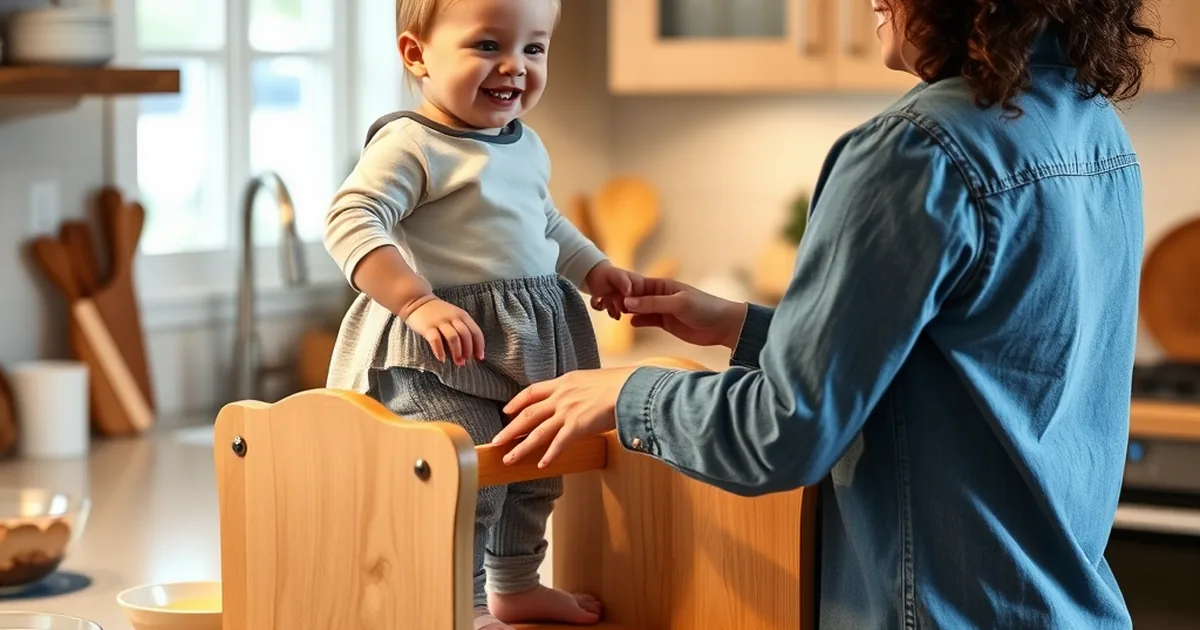
Toddler learning towers are adjustable step stools with safety rails that bring children to counter height for kitchen activities, washing hands, and participating in household tasks. The best models adjust as children grow, are stable enough to stand on unsupported, and are built to last through multiple children. Here are the four best toddler learning towers of 2026.
Learning Tower Original by Little Partners
The Learning Tower by Little Partners is the original toddler learning tower and the product that established the category in North America. It remains the benchmark for quality, stability, and height adjustability more than 15 years after its introduction. The four-sided safety rail surrounds the child on all sides, eliminating the lean-and-fall risk of open-sided step stools. The platform adjusts to four heights between 18 and 27 inches from the floor, covering children from 18 months through approximately 6 years as they grow.
The Learning Tower is made from solid hardwood (maple or poplar depending on the finish option) with a beeswax and oil finish that contains no formaldehyde or VOC-heavy lacquers. The weight capacity is 250 lb, which is adult-capacity and allows a parent to stand on the platform alongside the child during instruction. This weight capacity reflects the structural quality of the hardwood construction: the joints are mortise-and-tenon rather than screw-fastened, which distributes load across the wood grain rather than relying on hardware.
Available in natural wood, white, grey, and blue finishes, the Learning Tower integrates into kitchen design more gracefully than plastic alternatives. It does not fold flat, which is its main practical limitation: at 15x21 inches footprint, it requires dedicated storage space. Families with open kitchens typically store it near the counter; families with tight kitchen layouts may find the lack of fold more limiting.
At $199.99, the Little Partners Learning Tower is the premium option on this list. The hardwood construction, the four-height platform adjustment, the adult-weight capacity, and the design quality that makes it look at home in a modern kitchen justify the premium over plastic alternatives for families who view it as a long-term furniture item rather than a disposable toddler product.
Best for: Families who want a premium hardwood learning tower that integrates into kitchen design and lasts through multiple children with a 250 lb weight capacity.
Platform heights: 4 adjustable positions (18-27 inches)
Weight capacity: 250 lb
Price: $199.99
Guidecraft Classic Kitchen Helper Tower
The Guidecraft Kitchen Helper is the most stable learning tower on this list for active toddlers. Its four-legged base is wider than the Little Partners' design, which provides a lower center of gravity and more resistance to lateral forces from children who push against the rail while reaching across a counter. The wider base is a meaningful safety advantage for children 18-30 months who have less body awareness and are more likely to shift their weight unexpectedly.
The Kitchen Helper is made from birch veneer over an engineered wood frame - a construction that is more moisture-resistant than solid hardwood in kitchen environments and less likely to develop surface cracks with repeated cleaning. The platform adjusts via four wooden pegs that slide into height notches on the interior frame, covering six height positions from 17 to 27 inches. The adjustment requires removing the child from the tower, resetting the pegs, and reinserting the platform - a 2-minute process that most parents do monthly as the child grows.
The rail on three sides and an open-front design (the child enters and exits from the front-facing side) is the Guidecraft's primary design difference from the full four-sided rail of the Little Partners. The open front makes it easier for toddlers to climb in and out independently, which reduces resistance to using the tower. The three-sided rail still prevents the most common falls - rearward and lateral - while allowing the child more freedom of movement at the counter.
At $149.99, the Guidecraft Kitchen Helper is $50 less than the Learning Tower at a slightly lower platform height range and a different stability-versus-openness trade-off. For families who want solid construction, good stability, and the easier climb-in/out of the open-front design, the Guidecraft is the most practical value on this list.
Best for: Active toddlers who need a wider-base design for stability, with a three-sided rail and open front for easier independent entry and exit.
Platform heights: 6 adjustable positions (17-27 inches)
Construction: Birch veneer on engineered wood
Price: $149.99
STEP2 Lifestyle Kitchen Helper Toddler Learning Tower
The STEP2 Kitchen Helper is the only plastic learning tower on this list and the best choice for families who want the function of a learning tower at the lowest price with maximum durability against the specific hazard of kitchen moisture. Plastic does not warp, crack, or develop surface mold from repeated exposure to water splashes, wet hands, and the humidity of a working kitchen. For families who cook extensively with their toddlers and anticipate the tower being used daily for years, plastic's moisture resistance is a practical advantage over solid wood alternatives.
The STEP2 design uses the brand's signature thick-wall double-layered plastic that resists flexing under load. The single platform height is fixed at 21 inches - there is no height adjustment on the STEP2 model, which is the most significant limitation compared to the adjustable alternatives on this list. At 21 inches, the platform is appropriate for children 2-5 years old at average counter heights (36 inches), but does not accommodate the full height range from toddler to school-age that adjustable towers cover.
The Safety 1st certification and ASTM F963 compliance apply to the STEP2 Kitchen Helper. The weight capacity of 100 lb is lower than the hardwood alternatives but more than sufficient for the intended child age range. At 7 lb, it is the lightest tower on this list and can be moved by a toddler between the kitchen and bathroom for hand-washing use without parental assistance.
At $59.99, the STEP2 Kitchen Helper is the most affordable learning tower on this list by a significant margin. For families with a budget constraint, a single toddler who will outgrow the fixed height within 2-3 years, or a kitchen that sees heavy moisture exposure, the STEP2 delivers the core counter-height access function at the lowest price.
Best for: Budget-conscious families or those with high-moisture kitchens who want a durable plastic learning tower at the lowest price point.
Platform height: Fixed at 21 inches (no adjustment)
Weight capacity: 100 lb
Price: $59.99
BANKA Toddler Tower Step Stool with Adjustable Platform
The BANKA Toddler Tower is the best foldable learning tower on this list, collapsing flat for storage under a cabinet or behind a door without the dedicated storage footprint that solid-wood non-folding towers require. The fold uses a hinge mechanism at the rear rail that allows the side panels and platform to collapse inward to a 4-inch profile. For families in apartments or small kitchens where a permanent 15x21-inch footprint is not feasible, the BANKA's fold-flat capability makes it the only practical full-featured learning tower option.
The construction is birch plywood with a non-toxic water-based coating - lighter than solid hardwood but sufficiently rigid for the intended use. The platform adjusts to three heights (16, 19, and 22 inches) via a sliding platform that locks into position with a safety pin on each side. The three-position adjustment covers children 18 months through 5 years at standard counter heights. The weight capacity is 130 lb.
The folding hinge mechanism is the BANKA's defining feature and its most scrutinized component. The hinge uses metal connectors with safety locking pins that prevent unintended collapse when the tower is in use. The locking mechanism holds under normal use, but the fold adds a small amount of lateral give compared to the rigid one-piece frames of the Little Partners and Guidecraft. For most kitchen activities this is unnoticeable; for children who lean heavily on the front rail while reaching across a counter, the slightly reduced rigidity of the hinged design may be perceptible.
At $89.99, the BANKA Toddler Tower is priced between the STEP2 and the Guidecraft. It is the right choice for families who need foldable storage and have limited kitchen space, are willing to accept the minor rigidity trade-off of a hinged frame over a one-piece design. For families with sufficient kitchen space for a permanent footprint, the Guidecraft or Little Partners offers a more rigid experience at comparable or higher cost.
Best for: Families in apartments or small kitchens who need a fold-flat learning tower with adjustable height and birch plywood construction.
Platform heights: 3 positions (16, 19, 22 inches)
Folds flat: Yes (4-inch folded profile)
Price: $89.99
How to Choose a Toddler Learning Tower
Safety rail design: four-sided vs. three-sided vs. open-front
Four-sided rails (Little Partners) prevent all lateral and rearward falls but require children to be lifted in and out by a parent. Three-sided rails (Guidecraft, most alternatives) allow independent entry and exit from the front while preventing lateral and rearward falls. Open-front designs reduce toddler resistance to using the tower because children can climb in themselves. For children under 2 years, four-sided rails with parent-assisted entry are the safest. For children 2 years and older who climb confidently, three-sided or open-front designs improve daily usability.
Height adjustment range
The standard US kitchen counter is 36 inches. For a toddler's eyes and hands to reach comfortably over the counter edge, the learning tower platform needs to bring them to approximately 28-32 inches standing height. At 18 months, most children stand 30-33 inches tall; at 5 years, 42-46 inches tall. A tower that adjusts from 17 to 27 inches covers this range in most kitchen configurations. A fixed-height tower at 21 inches serves approximately 2-5 years at standard counter height.
Wood vs. plastic
Solid hardwood and birch plywood towers (Little Partners, Guidecraft, BANKA) are more rigid, have higher weight capacities, and integrate into kitchen design more naturally. They are more susceptible to moisture damage and require more care to clean. Plastic towers (STEP2) are moisture-proof, lower cost, and lighter but have fixed heights and lower weight capacities. For families who cook daily with their toddler and treat the tower as a long-term investment, hardwood is the better material. For families with a single child or a tight budget, plastic delivers the core function reliably.
Frequently Asked Questions
At what age can a toddler use a learning tower?
Most learning towers accommodate children from 18 months to 6 years. At 18 months, children need a parent nearby and should be monitored continuously. By 2.5-3 years, most children can use a learning tower with the parent present but not holding. Independent use without a parent in the same room is not recommended until the child is reliably stable on the platform, typically 4-5 years.
Can a toddler use a learning tower at the bathroom sink?
Yes. Most learning towers are used at both the kitchen counter and the bathroom sink for hand washing. Freestanding towers can be moved between rooms easily. For bathroom use, lightweight models (STEP2 at 7 lb, BANKA at 12 lb) that a toddler can move themselves reduce the need for parental assistance in establishing hand-washing independence.
Are learning towers better than step stools?
For toddlers under 3 years, yes. Standard step stools have no safety rails and are appropriate for children old enough to manage the fall risk of standing on a single-step platform. Learning towers' safety rails eliminate that fall risk and allow unsupported standing at counter height from 18 months. For children 4 years and older with good balance, a wide-step stool is a simpler and lower-cost alternative to a learning tower.