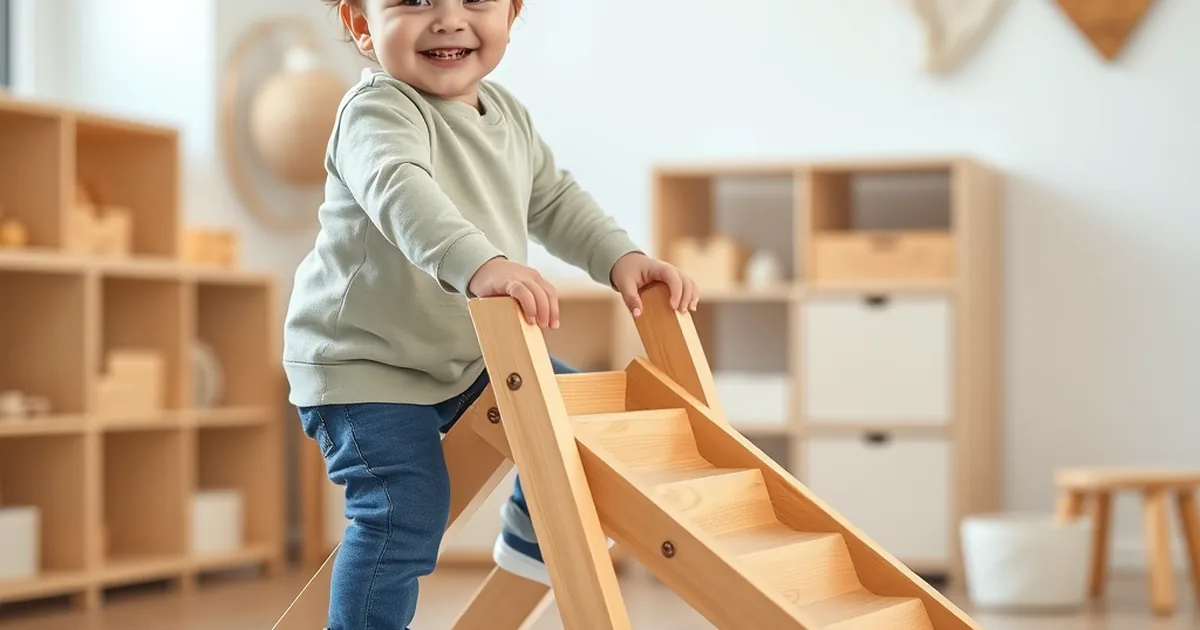
Pikler triangles are wooden climbing frames that let toddlers practice climbing, balance, and risk assessment at home from about 6 months through 5 years. The best models are built from hardwood with rounded rungs that small hands can grip, fold flat for storage, and accept ramps and arches that extend the play as the child grows. Here are the four best Pikler triangles and climbing sets of 2026.
Lily and River Little Climber
The Lily and River Little Climber is the best-built Pikler triangle sold in the United States and the one most often chosen by families who want the climber as a permanent piece of playroom furniture rather than a toy. Lily and River builds the climber in Arizona from Baltic birch and hardwood dowels, sands every edge by hand, and finishes it with a food-safe oil rather than a lacquer, so the wood has a warm, matte surface that toddlers can mouth safely. The company's reputation is built on quality control that mass-produced imports do not match: the rungs are tight, the hinges are solid, and the frame does not wobble.
The Little Climber is 33 inches tall and folds flat to 6 inches for storage under a bed or behind a door. It supports 150 lb, so a parent can climb alongside a toddler. The set is sold as the triangle alone or bundled with a reversible ramp that has a climbing rock wall on one side and a smooth slide on the other. The ramp hooks over any rung, which changes the angle from a gentle incline for a 1-year-old to a steep slide for a 4-year-old.
Lily and River also sells an arch and a rocker that connect to the climber, so families can build out a full climbing course over time. Everything ships assembled except for a few bolts. The natural finish can be refreshed with the same food-safe oil as the wood wears.
At $249.99 for the climber with ramp, the Lily and River is the most expensive option on this list. For families who want an heirloom-quality climber that will pass to a second and third child and be resold for most of its price afterward, the US-made construction and hand finishing are what the premium buys.
Best for: Families who want a US-made, hand-finished heirloom climber with a reversible rock wall and slide ramp.
Material: Baltic birch and hardwood dowels, food-safe oil finish
Capacity: 150 lb, folds to 6 inches
Price: $249.99
Piccalio Mini Climber Set
The Piccalio Mini Climber is the best Pikler triangle set on this list for small apartments and for families who want the triangle, a ramp, and an arch in one purchase at a price below buying them separately. Piccalio designs its climbers for urban homes: the Mini Climber is 26 inches tall, smaller than most triangles, and the whole set folds and nests to a compact bundle that fits in a closet. For families in a one-bedroom apartment where a 33-inch triangle would dominate the living room, the Mini Climber's size is the deciding feature.
The set includes the folding triangle, a reversible ramp (rock wall on one side, slide on the other), and a climbing arch that doubles as a rocker when flipped. The pieces connect to each other so a toddler can climb up the triangle, over the arch, and down the ramp in one course. The frame is birch plywood with beech dowels, finished with a water-based non-toxic lacquer in natural or a range of muted colors.
The Mini Climber supports 60 lb, which covers most children through age 4. It is not designed for adults to climb. The smaller size means it is outgrown sooner than a full-size triangle; Piccalio sells a larger climber for families who want to size up. Assembly takes about 20 minutes per piece with the included hex key.
At $199.99 for the three-piece set, the Piccalio is a strong value for a complete climbing course, and its footprint is the smallest on this list. For families in apartments or with limited playroom space who want the full triangle-arch-ramp experience, the Piccalio is the most practical set available.
Best for: Apartments and small spaces, with a 26-inch triangle, reversible ramp, and rocker arch that nest into a compact bundle.
Set: Triangle, ramp, and arch
Capacity: 60 lb, compact folding
Price: $199.99
Wiwiurka Foldable Climbing Triangle
The Wiwiurka is the best-designed Pikler triangle on this list and the one most photographed in Montessori playroom features, made by a family workshop in Mexico from solid pine and hardwood dowels with a hand-applied natural finish. What distinguishes the Wiwiurka is proportion and finish: the rungs are spaced for small children, the wood is left visibly natural with the grain showing, and the color options are muted stains rather than paint. The triangle is a piece of furniture that many parents leave out in the living room.
The Wiwiurka is 33 inches tall and folds flat with a locking mechanism that holds the frame rigid when open and collapses with a single lever. It supports 130 lb. The company sells a matching reversible ramp and an arch, both in the same finish, and the pieces connect to the triangle at any rung. The natural finish is a beeswax and oil blend that can be reapplied at home.
Because the Wiwiurka is handmade in small batches, lead times can be several weeks and stock varies. The pine construction is slightly softer than Baltic birch, so it will show dents from hard use more readily, though most families view the wear as character. Assembly is minimal; the triangle ships nearly complete.
At $179.99 for the triangle alone, the Wiwiurka is priced between the Piccalio set and the Lily and River. For families who prioritize the natural aesthetic and the handmade quality, and who are willing to wait for a small-batch product, the Wiwiurka is the most beautiful climber on this list.
Best for: Families who want a handmade, natural-finish triangle that doubles as living room furniture in a Montessori-style home.
Material: Solid pine and hardwood dowels, beeswax oil finish
Capacity: 130 lb, single-lever fold
Price: $179.99
Costzon Foldable Climbing Triangle with Ramp
The Costzon is the best-value Pikler triangle on this list and the one to buy for a family that wants to try a climbing triangle before committing to a premium set. It includes a 30-inch folding triangle and a reversible ramp with a rock wall and slide, in a natural finish or a two-tone color scheme, at less than half the price of the Lily and River set. The rungs are beech dowels on a pine frame, and the finish is a water-based lacquer.
The Costzon's folding hinge is functional, and the triangle supports 110 lb. The rock wall side of the ramp uses molded plastic grips rather than the wooden grips on the premium sets, which are less attractive but easier for small hands to hold. The set includes an anti-slip pad for the ramp on hard floors. Assembly takes about 40 minutes with the included tools.
The trade-offs are the ones expected at the price: the sanding is less thorough, the hardware is lighter, and the frame will wobble slightly over time if the bolts are not retightened every few months. The Costzon will last through one child's climbing years; it is not an heirloom piece. Families who find their toddler uses the climber daily often upgrade to a premium set and pass the Costzon to a friend.
At $99.99 for the triangle and ramp, the Costzon is the most affordable option on this list. For families uncertain whether a climbing triangle will get used, or who want a set for a second home or grandparents' house, it is the low-risk way to find out.
Best for: Families trying a climbing triangle for the first time, or equipping a second home, at the lowest price for a triangle plus ramp.
Set: Triangle and reversible ramp
Capacity: 110 lb
Price: $99.99
How to Choose a Pikler Triangle
What is a Pikler triangle and why do toddlers need to climb?
The Pikler triangle was designed by Hungarian pediatrician Emmi Pikler in the early 20th century as a climbing frame that lets infants and toddlers move at their own pace without adult assistance. Climbing develops gross motor strength, coordination, spatial awareness, and the ability to assess risk. The triangle is deliberately low, so a fall is a short drop onto a mat rather than an injury. Pikler's principle was that children should only climb what they can climb themselves, which is why the triangle is never used to place a child at a height they did not reach on their own.
What size triangle is right?
Mini triangles (26 inches) suit 6 months to 3 years and small homes. Standard triangles (30-33 inches) suit 6 months to 5 years. A taller triangle is used for longer but takes more space and is a bigger fall for a young toddler. Adult weight capacity (130 lb and up) means a parent can spot from the frame itself, which is useful in the first year of climbing.
Do you need the ramp and arch?
The triangle alone is enough for the first year. A reversible ramp adds a slide, a rock wall, and a bridge, and it is the accessory most families add first. An arch adds a rocker and a tunnel. Buying a set at the start is cheaper than adding pieces later, but a triangle-only purchase is a reasonable way to start for families unsure about space.
Frequently Asked Questions
At what age can a baby use a Pikler triangle?
From about 6 months, once the baby can pull to a stand, they will use the lowest rungs to practice pulling up. Real climbing starts around 12-15 months. Most children use a triangle actively until 4-5 years, at which point they outgrow the height and move to playground equipment. The triangle's long span of use is why it justifies its price for many families.
Is a Pikler triangle safe?
Yes, when used as designed: on a flat floor, with a soft mat underneath, with the fold lock engaged, and with a parent nearby during the first months of use. Children should climb only as high as they can on their own and should never be lifted onto the frame. Check the bolts every few months and retighten as needed. A triangle should not be placed near windows, stairs, or furniture that a child could climb onto from the top rung.
Can a Pikler triangle be used outside?
Most are finished for indoor use. Unfinished or oil-finished wood will weather outdoors and the hinges may rust. A triangle can be taken outside for an afternoon on a deck or lawn and brought back in, but it should not be left outdoors. Families who want a permanent outdoor climber should look at cedar or treated-wood play structures instead.