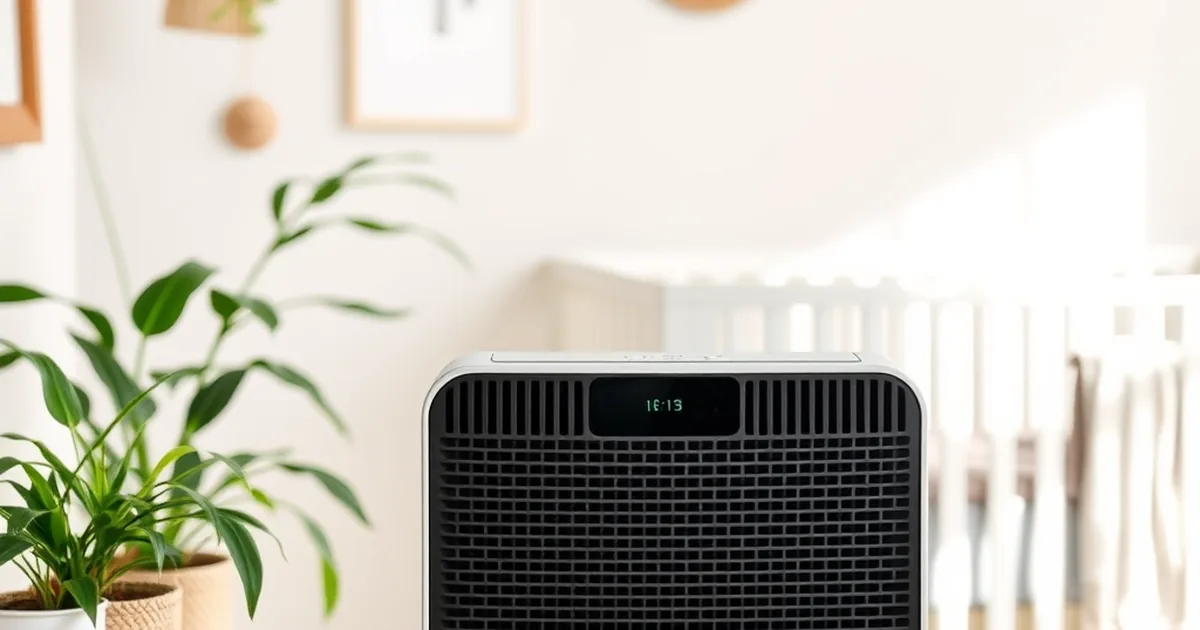
Newborns spend up to 18 hours a day in their nurseries, and the air they breathe directly affects their respiratory development and sleep quality. A good nursery air purifier removes ultrafine particles, allergens, pet dander, and VOCs from paint, furniture, and carpeting that are especially concentrated in newly decorated rooms. Here are the four best nursery air purifiers of 2026, chosen for filtration effectiveness, noise levels appropriate for sleeping babies, and ease of use.
Dyson Purifier Cool Gen1 TP10
The Dyson TP10 is a combined air purifier and fan, which makes it the most versatile option for nurseries where temperature control and air quality are both concerns. It removes 99.97% of particles as small as 0.3 microns, including pollen, pet dander, dust mite debris, and mold spores. The sealed HEPA and activated carbon filter combination also captures VOCs from new furniture and paint finishes common in freshly decorated nurseries.
The 360-degree filtration inlet means the TP10 captures particles from all directions, not just the front of the unit. The Dyson Link app shows real-time air quality readings, particle counts, and VOC levels on your phone. Auto mode adjusts fan speed based on detected air quality, so it runs quietly at low speed when air is clean and increases automatically when it detects a spike.
The bladeless fan design eliminates any exposed blades, which is an important safety feature in a nursery where curious toddlers will eventually be within reach. The oscillating flow moves purified air throughout the room without creating drafts that could chill a sleeping baby. At night, the display can be dimmed and the fan runs at its quietest setting (45 dB).
At $399.99, the Dyson TP10 is the most expensive option on this list and one of the most expensive air purifiers in its class. But for parents who want real-time air quality data, fan function, and Dyson's build quality in a single unit, it is the most capable nursery air quality solution available.
Best for: Parents who want a combined air purifier and fan with real-time air quality monitoring and Dyson's build quality.
Coverage area: 800 sq ft
Noise level: 45-60 dB (sleep mode to high)
Price: $399.99
Coway AP-1512HH Mighty Air Purifier
The Coway AP-1512HH has been the best-reviewed mid-range air purifier on Amazon for years, and it earns that reputation with consistent filtration performance, a low noise floor, and a price that is accessible without sacrificing effectiveness. It uses a four-stage filtration system: pre-filter, activated carbon, True HEPA (captures 99.97% of particles 0.3 microns or larger), and an optional ionizer.
The Mighty's auto mode uses a built-in air quality sensor to adjust fan speed in real time. The LED ring indicator shows air quality at a glance: green for clean, yellow for moderate, red for poor. The display turns off automatically in the dark, which is essential for nurseries where light sensitivity can disrupt sleep. The night mode runs the fan at its quietest setting (24.4 dB), which is quieter than a whisper and appropriate even for light-sleeping infants.
At 7.7 lb and 16.8" tall, the Coway Mighty fits on a dresser or floor easily without dominating a small nursery. Filter replacement is intuitive and costs approximately $30-40 per year at average use. The unit shuts off automatically when the pre-filter drawer is opened, preventing accidental exposure to unfiltered air during maintenance.
At $129.99, the Coway AP-1512HH is the best value on this list by a significant margin. For parents who want a proven, reliable, quiet air purifier without the premium of Dyson or Levoit's smart features, the Mighty delivers clean nursery air at a fraction of the cost.
Best for: Parents who want the best-documented filtration performance in a quiet, compact unit at a budget-friendly price.
Coverage area: 360 sq ft
Noise level: 24.4-53.8 dB
Price: $129.99
Levoit Core 400S Smart True HEPA Air Purifier
The Levoit Core 400S is the best smart air purifier for parents who want app control without Dyson's price. The VeSync app lets you schedule run times, monitor filter life, check air quality history, and adjust settings without walking to the nursery or disturbing a sleeping baby. Alexa and Google Assistant integration means you can control it by voice from another room.
The Core 400S uses QuietKEAP technology to reduce noise to 24 dB on sleep mode, which is genuinely inaudible at typical nursery distances. The 3-in-1 filter (pre-filter, True HEPA, and activated carbon) captures particles, allergens, and odors including the paint and adhesive off-gassing common in newly assembled nursery furniture. Filter replacement is a single pull-and-replace process that takes under 30 seconds.
The 2,153 sq ft coverage area is larger than most nurseries will ever require, meaning the Core 400S can run at lower fan speeds (and lower noise) while still achieving adequate air changes per hour. The unit is 14.4" tall and fits easily on a dresser top or beside a changing table without occupying significant floor space.
At $199.99, the Levoit Core 400S sits between the Coway and Dyson on price and offers app connectivity that the Coway lacks. For tech-comfortable parents who want to manage nursery air quality from their phones without paying for Dyson's fan function, this is the strongest mid-range option.
Best for: Tech-comfortable parents who want app control and smart home integration without paying for a combined fan unit.
Coverage area: 2,153 sq ft
Noise level: 24-52 dB
Price: $199.99
Blueair Blue Pure 211+ Auto Air Purifier
Blueair's Blue Pure 211+ Auto is the most stylish air purifier on this list, with a fabric pre-filter available in eight colors that can match any nursery decor. The design-forward approach does not sacrifice function: the 211+ Auto covers rooms up to 550 sq ft and runs whisper-quiet at 31 dB on its lowest setting, which is appropriate for sleeping infants.
The Auto function uses a built-in particle sensor to adjust fan speed automatically. The pre-filter is washable, which reduces the ongoing filter cost compared to disposable-only systems. The main combination HEPA and activated carbon filter captures particles, allergens, and household odors and needs replacement approximately once a year with average nursery use.
Blueair's HEPASilent technology combines mechanical and electrostatic filtration, which Blueair claims removes 99.97% of airborne particles at higher efficiency than mechanical HEPA alone. The unit requires no Wi-Fi or app connectivity, which means there is nothing to set up beyond plugging it in and turning it on. For parents who want simplicity and style, the 211+ Auto delivers both.
At $279.99, the Blueair 211+ Auto is the second most expensive option on this list. The premium covers the design quality, washable pre-filter, and HEPASilent technology. For parents who care about nursery aesthetics and want a purifier that looks intentional rather than industrial, the 211+ Auto is the most visually cohesive choice.
Best for: Design-conscious parents who want a stylish, quiet air purifier with a washable color-coordinated pre-filter.
Coverage area: 550 sq ft
Noise level: 31-56 dB
Price: $279.99
What to Look for in a Nursery Air Purifier
True HEPA vs. HEPA-type filters
True HEPA filters are rated to capture 99.97% of particles 0.3 microns or larger, as tested by IEST standards. HEPA-type or HEPA-like filters are not certified to this standard and may have lower efficiency. All four purifiers on this list use True HEPA filtration. When comparing purifiers, confirm the filter is labeled "True HEPA" or "H13 HEPA," not just "HEPA-style."
Noise levels for nursery use
Under 30 dB is appropriate for sleeping babies and comparable to a quiet bedroom. 30-40 dB provides white noise similar to a quiet library and can actually help some babies sleep. Over 50 dB is too loud for a sleeping space. The Coway AP-1512HH and Levoit Core 400S both achieve 24 dB on sleep mode, the quietest on this list.
How large is your nursery?
Air purifiers are rated for room size. Match the coverage area to your nursery size with room for overhead: a purifier rated for 360 sq ft in a 200 sq ft nursery will achieve more air changes per hour (meaning cleaner air) than one rated exactly to room size. For a standard 10x12 nursery, any purifier on this list is more than sufficient.
VOC filtration for new nurseries
Freshly painted walls, new carpet, and assembled furniture emit VOCs (volatile organic compounds) including formaldehyde and benzene for weeks after installation. The activated carbon filter layer in all four purifiers on this list captures VOCs. If your nursery was recently decorated, run the purifier continuously on high for the first week to clear initial off-gassing.
Frequently Asked Questions
Do babies need an air purifier in the nursery?
An air purifier is not medically required, but it is particularly beneficial in homes with pets, in urban areas with outdoor pollution, in newly renovated spaces, or for babies with known allergies in the family. Newborn lungs are developing, and reducing airborne particle load during the first year is a precautionary benefit many pediatricians endorse.
Where should I place an air purifier in a nursery?
Place the purifier at least 3 feet from the crib on an open floor or low surface, away from walls and furniture that block airflow. The purifier needs clear space on all sides to draw in air and exhaust filtered air. Avoid placing it directly under the crib or in a corner where airflow is restricted.
How often do I need to replace the filter?
Most True HEPA filters need replacement every 6-12 months depending on air quality and run time. The Coway pre-filter is washable monthly and extends main filter life. The Blueair pre-filter is washable. Budget $30-80/year for replacement filters, with Coway typically at the lower end and Dyson at the higher end.
Can I run an air purifier and a humidifier in the same nursery?
Yes, and it is common to run both. Place them at opposite sides of the room to prevent the humidifier's moisture from reducing the air purifier's filtration efficiency. High humidity can cause HEPA filter media to absorb water and degrade faster, so maintain nursery humidity between 40-60% for optimal filter longevity.
Are ionizers safe in a nursery?
Some air purifiers include optional ionizers. Ionizers produce small amounts of ozone as a byproduct, which can irritate infant respiratory systems at high concentrations. The Coway AP-1512HH has an optional ionizer that is off by default and can be left off for nursery use. The other purifiers on this list do not include ionizers.
How do I know if the air purifier is working?
Purifiers with particle sensors (Coway, Levoit, Dyson) show real-time air quality readings. For purifiers without displays (Blueair), a clean pre-filter and scheduled filter replacement confirm operation. You can also use a standalone air quality monitor (around $30-50) to verify particle reduction before and after the purifier runs.
Do air purifiers remove baby smells from the nursery?
The activated carbon filter in all four purifiers on this list absorbs odor-causing molecules, including diaper odors, spit-up, and general baby smells. Carbon filters have a finite capacity to absorb odors before they become saturated. At the one-year replacement interval, the carbon layer should still be effective at capturing nursery odors.
What is CADR and why does it matter?
CADR (Clean Air Delivery Rate) measures how quickly an air purifier can filter a specific room size, measured in cubic feet per minute for smoke, dust, and pollen. Higher CADR means faster air cleaning. The Levoit Core 400S and Dyson TP10 have the highest CADR on this list. For nurseries under 300 sq ft, the Coway's CADR is more than sufficient.