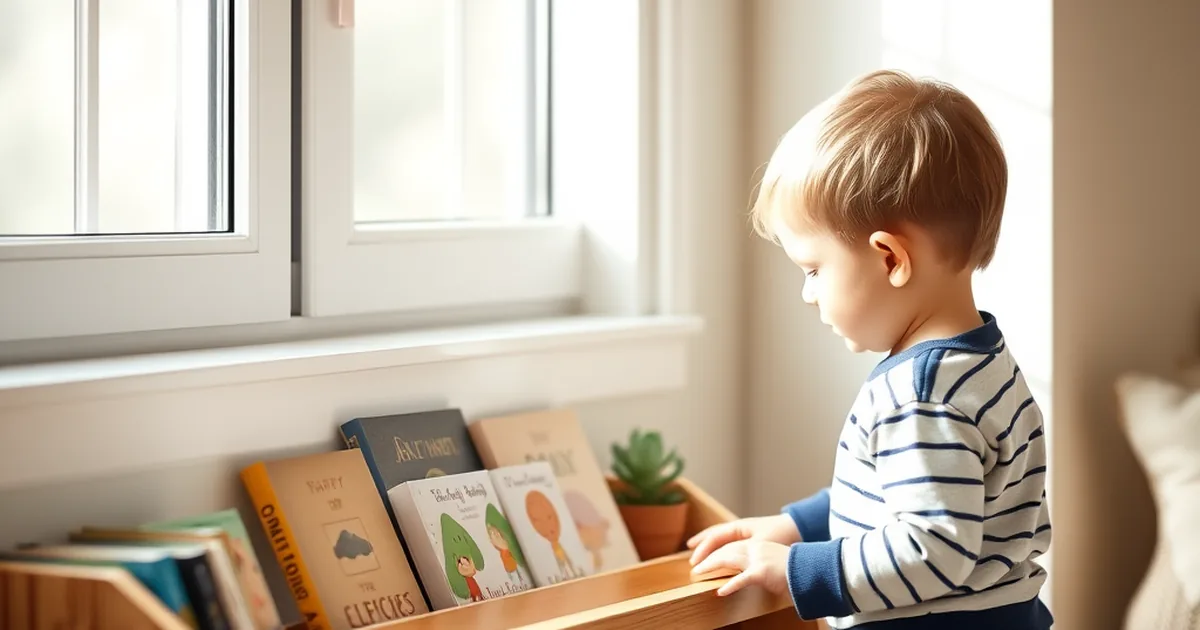
Kids bookshelves display books with covers facing out at toddler height, which is the single design feature that most increases how often a young child picks up a book on their own. The best shelves are low and anchored or weighted so they cannot tip, hold enough books for a growing library, and are built to survive being climbed. Here are the four best kids bookshelves of 2026.
Guidecraft Classic Bookshelf
The Guidecraft Classic Bookshelf is the best-built kids bookshelf on this list and the one found in Montessori classrooms, because it is designed to the standards of institutional furniture: solid birch construction, rounded edges, and a low, wide profile that a toddler cannot tip. It is a two-sided unit, with front-facing display shelves on one side for the current rotation of books and open storage shelves on the back for the rest, which makes it a room divider in a playroom or a freestanding reading nook in a bedroom.
The front-facing side has four tiered display shelves, each with a lip that holds books with covers out, which is the Montessori principle of letting a child see and choose. The back side has three deep storage shelves. The unit is 36 inches tall and 36 inches wide, with a 12-inch depth that keeps it stable without wall anchoring, though a tip-restraint kit is included. The birch is finished with a clear, non-toxic lacquer.
The Guidecraft holds approximately 60-80 picture books across both sides. It ships flat and assembles in about 45 minutes. It is heavy at 48 lb, which is the source of its stability. The brand sells matching toy storage and cubbies in the same finish.
At $199.99, the Guidecraft is the most expensive bookshelf on this list. For families who want a classroom-grade, two-sided unit that works as a room divider and lasts through multiple children, it is the shelf that justifies the price.
Best for: Families who want a two-sided, classroom-grade birch unit with front-facing display on one side and storage on the other.
Material: Solid birch, non-toxic lacquer
Capacity: 60-80 picture books, 2-sided
Price: $199.99
KidKraft Bookcase with Reading Nook
The KidKraft Bookcase with Reading Nook is the best bookshelf on this list for a child's bedroom, because it combines a bookshelf with a cushioned seat where the child can sit and read. The unit is a low, wide bookcase with shelves on both ends and a padded bench in the middle, with storage cubbies under the seat. The nook invites a child to sit with a book rather than carrying it off to the floor, which, for a 3-5 year old, is the difference between a shelf that stores books and a shelf that gets used.
The bookcase is 50 inches wide and 30 inches tall, with the reading seat 12 inches off the floor. The two end sections have three shelves each, and two cubbies under the seat hold bins or larger books. The cushion is removable and the cover is washable. The construction is engineered wood with a painted finish in white, gray, espresso, or natural.
The KidKraft holds about 50 books on the end shelves plus whatever fits in the cubbies. The shelves are standard depth rather than front-facing display, so books are spine-out. The unit should be anchored to the wall; a kit is included. Assembly takes about an hour.
At $149.99, the KidKraft Bookcase with Reading Nook is mid-range on this list. For a child's bedroom where a dedicated reading spot matters, and for families who want a shelf that is also furniture a child will sit on, it is the most inviting design here.
Best for: A child's bedroom, with a cushioned reading seat between two bookshelf ends and storage cubbies under the seat.
Material: Engineered wood, painted finish
Features: Padded reading nook, 2 cubbies, 6 shelves
Price: $149.99
Tidy Books Children's Bookcase
The Tidy Books Children's Bookcase is the best wall-mounted front-facing bookshelf on this list and the one for families who want to display books at eye level without a freestanding unit taking floor space. Tidy Books is a UK brand built around a single idea: books with covers forward, at a child's height, so the child can see every cover and choose. The bookcase is a slim, four-tier wall-mounted unit, only 3 inches deep, that holds about 60 picture books cover-out.
The Tidy Books is made from solid wood and plywood with a water-based finish in natural, white, or a few colors, and the version with a painted alphabet along the shelf edges is the brand's signature. It mounts to the wall with included hardware, so it has no tipping risk and no footprint. At 45 inches tall, the top shelf is within reach of a 3-year-old when the unit is mounted with the bottom shelf near the floor.
Because it is wall-mounted, the Tidy Books requires drilling into studs or using appropriate anchors, and it is not movable without re-mounting. It holds only picture books and thin paperbacks; thick chapter books do not fit the shallow shelves. For the picture-book years, this is the shelf that most directly puts books where a toddler will pick them up.
At $169.99, the Tidy Books is priced above the KidKraft and below the Guidecraft. For families who want front-facing display with zero floor space, and who are comfortable mounting a shelf to the wall, it is the best realization of the cover-out principle on this list.
Best for: Families who want front-facing cover-out display with no floor footprint, wall-mounted at toddler eye level.
Material: Solid wood and plywood, wall-mounted
Capacity: About 60 picture books, 4 tiers
Price: $169.99
Delta Children Deluxe Book and Toy Organizer
The Delta Children Deluxe Book and Toy Organizer is the best-value kids bookshelf on this list and the one that most families buy for a first nursery or playroom, combining a sling bookshelf with fabric toy bins in one unit. The sling shelves hold books cover-out in three fabric pockets, which is a lower-cost way to achieve front-facing display than a wooden tiered shelf, and the four fabric bins below hold toys. It is available in a dozen colorways including licensed character themes.
The unit is 33 inches wide and 32 inches tall, with a wooden frame and fabric slings and bins. The slings hold about 30 picture books, and the bins hold a toddler's worth of blocks, cars, and stuffed animals. The frame is engineered wood with a painted finish, and the fabric components remove for washing. The unit should be anchored to the wall with the included kit.
The Delta is not a long-term piece: the fabric slings stretch over a few years and the frame is lightweight. It is a nursery-to-preschool organizer that does its job for 3-4 years at a low price. For a first bookshelf for a 1-3 year old, it puts books cover-out where the child can see them and keeps toys in bins, which is most of what a toddler needs.
At $69.99, the Delta Children Deluxe is the most affordable bookshelf on this list. For families who want front-facing book display and toy storage in one inexpensive unit for the toddler years, it is the practical first purchase.
Best for: A first nursery or playroom organizer, with fabric sling shelves for cover-out books and four toy bins at the lowest price.
Material: Engineered wood frame, fabric slings and bins
Capacity: About 30 books plus 4 toy bins
Price: $69.99
How to Choose a Kids Bookshelf
Front-facing or spine-out?
Front-facing display (Guidecraft, Tidy Books, Delta slings) shows covers, which toddlers recognize and choose by. Spine-out shelving (KidKraft) holds more books in less space but requires a child to read or remember titles. For children under 5, front-facing display measurably increases independent book selection. A common approach is a front-facing shelf for a rotating selection of 20-30 books, with the rest stored spine-out and swapped in monthly.
How tall should a kids bookshelf be?
The top shelf should be reachable by the child without climbing: about 30-36 inches for a 2-4 year old. Low, wide shelves are also more stable. Any shelf a child can reach is a shelf a child will try to climb, so anchor every freestanding unit to the wall with the included kit regardless of how stable it feels.
Wood or fabric?
Solid wood (Guidecraft, Tidy Books) lasts through multiple children and can be refinished. Engineered wood (KidKraft) is durable for several years at lower cost. Fabric slings (Delta) are the cheapest and most portable but stretch and wear over 3-4 years. Match the material to the expected lifespan: a nursery organizer can be fabric; a playroom shelf for three children should be wood.
Frequently Asked Questions
How many books should be on a toddler's bookshelf?
Fewer than you think. A rotating display of 15-30 books is more effective than 100 on a shelf, because a toddler can see and choose from a small set and gets bored with a static one. Store the rest and rotate monthly or seasonally. The sense of novelty when a stored book reappears is as good as a new book.
Do kids bookshelves need to be anchored?
Yes. Furniture tip-overs injure thousands of children every year, and bookshelves are a leading cause because children climb them. Every freestanding shelf on this list includes an anti-tip kit; use it. Wall-mounted shelves (Tidy Books) eliminate the tip risk entirely but must be mounted into studs or with rated anchors.
At what age should a child have their own bookshelf?
From the time they can crawl to it, about 9-12 months. A low front-facing shelf with board books in reach lets a baby pull books down and look at them, which is the beginning of independent reading behavior. By 2-3 years, a child with an accessible shelf will choose books on their own several times a day.