
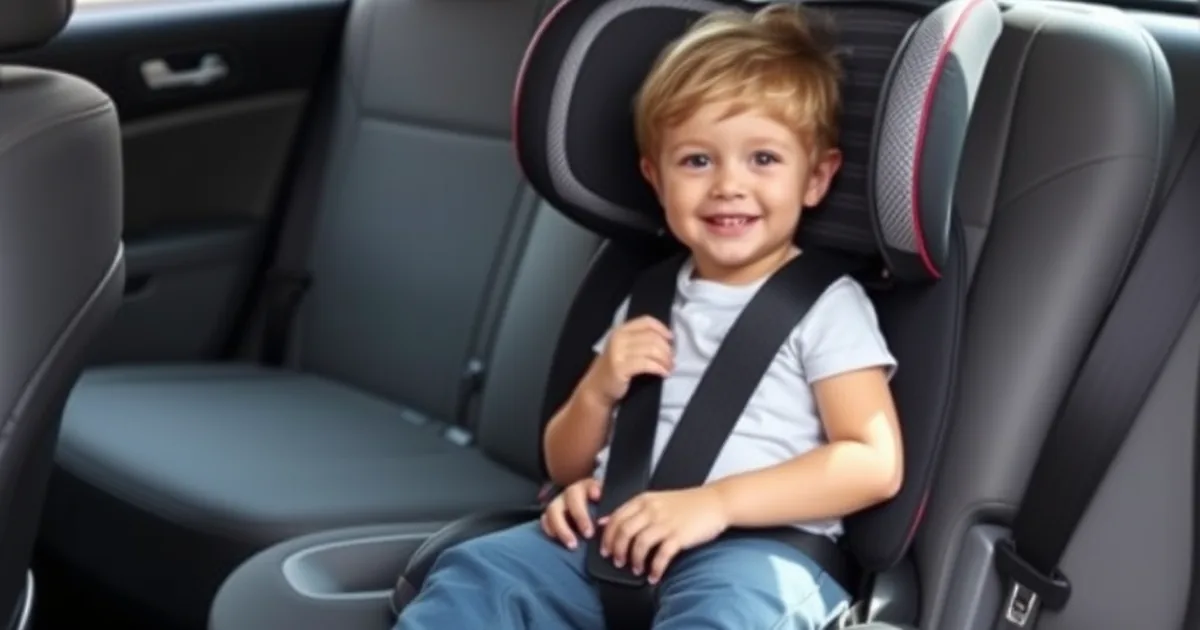
Booster car seats are for children who have outgrown forward-facing harnessed car seats and need a belt-positioning booster to correctly fit the vehicle's seat belt. The transition matters: an adult seat belt that crosses a child's stomach instead of their hip bones significantly increases injury risk in a crash. The best booster seats position the shoulder belt across the collarbone and the lap belt across the hip bones for every child, in every vehicle. Here are the four best booster car seats of 2026.
Britax Highpoint ClickTight Belt-Positioning Booster
The Britax Highpoint brings ClickTight installation technology to the booster seat category, providing a secure LATCH installation at the lower weight range and a belt-positioning function once the child outgrows the harness. The built-in ClickTight interface uses the seat belt itself for installation: open the front of the seat, route the belt through the channel, close the front, and the booster is installed as firmly as a car seat without tug-testing or rethreading.
The Highpoint starts as a high-back booster with an adjustable headrest that grows with the child from 40 lb to 120 lb. The SafeCell impact protection system includes a steel-reinforced frame, energy-absorbing foam, and a no-rethread harness. Side impact protection cushions extend from the headrest to the armrests, creating a protective cocoon for the child's head, neck, and torso.
Two recline positions accommodate different vehicle seat angles without requiring removal and reinstallation. The cup holders remove and are dishwasher-safe, which is a small but genuinely appreciated feature when juice boxes are involved. The cover removes and machine washes on cold.
At $249.99, the Britax Highpoint is the premium choice on this list. For parents who want Britax's reputation for safety engineering, ClickTight installation confidence, and a booster that covers their child from 40 lb through car seat age-out, it is the most complete option available.
Best for: Parents who want ClickTight installation confidence and comprehensive side-impact protection in a high-back booster.
Weight range: 40-120 lb
Height range: 38-63"
Price: $249.99
Chicco GoFit Plus Backless Booster
The Chicco GoFit Plus is the best backless booster seat on this list, designed for children who have graduated from a high-back booster and only need a seat cushion to correctly position the vehicle's lap and shoulder belts. It is appropriate for children who are 4 years or older, 40 lb or more, and can sit with their back straight against the vehicle seat for an entire car trip without slouching.
The GoFit Plus includes a removable positioning clip that holds the shoulder belt at the correct position across the chest without the child needing to hold it. The seat surface is padded with a machine-washable cover, and the two cup holders are repositionable for left- or right-hand access. The unit folds flat for storage or air travel as a checked item.
Backless boosters are appropriate for older children in vehicles with high seat backs or integrated headrests that provide head support. For vehicles with low seat backs where the child's head is above the seat, a high-back booster is the safer choice. Confirm your vehicle's seat back height before choosing a backless booster.
At $149.99, the Chicco GoFit Plus is the mid-range option for a booster seat designed for children who are truly ready for backless use. For families with older children (6+ years) who only need the belt positioning function of a booster, the GoFit Plus is a clean, high-quality Chicco option at a reasonable price.
Best for: Older children (6+ years) in vehicles with adequate seat back height who only need a belt-positioning booster cushion.
Weight range: 40-110 lb
Height range: 38-57"
Price: $149.99
Diono Monterey 4DXT Latch Expandable High Back Booster
The Diono Monterey 4DXT is the most adaptable high-back booster on this list, with four directions of adjustment built into the name: height, depth, width, and recline. The expandable headrest adjusts in all four dimensions rather than just height, which accommodates children with unusually wide or narrow shoulders, long or short torsos, and vehicle seats with different angle characteristics.
The 4DXT installs via LATCH at the low end of the weight range for firmness in carpooling situations, and the seat belt positioning guide correctly routes the shoulder belt for children from 40 lb through 120 lb. The Monterey includes reinforced steel construction, energy-absorbing headrest foam, and a deep side wall that wraps around the child's torso for side-impact energy management.
The seat folds flat when not in use, which is useful for carpooling families who move the booster between vehicles. Two removable, dishwasher-safe cup holders are positioned at the front of the armrests for easy child access. The machine-washable cover handles the typical juice and snack accumulation of years of car rides.
At $199.99, the Diono Monterey 4DXT sits between the Chicco and Britax in price. For parents who need the most adjustability in a high-back booster, particularly for children with non-standard proportions or parents who switch the seat between different vehicles regularly, the four-direction adjustment system is a meaningful advantage.
Best for: Parents who need maximum adjustability for differently-proportioned children or multiple vehicle configurations.
Weight range: 40-120 lb
Height range: 38-63"
Price: $199.99
Graco Tranzitions 3-in-1 Harness Booster
The Graco Tranzitions is the longest-use booster seat on this list, functioning as a 5-point harness car seat (30-65 lb), a high-back belt-positioning booster (30-100 lb), and a backless belt-positioning booster (40-100 lb). This three-stage design covers a child from preschool through elementary school without requiring a new seat at each transition.
The harness mode is the key differentiator from other boosters. Children can remain in the 5-point harness longer than most forward-facing seats allow - up to 65 lb - before transitioning to the belt-positioning booster function. The no-rethread harness adjusts in one step without removing the seat from the vehicle, and the Simply Safe Adjust system moves the headrest and harness simultaneously.
Graco's InRight LATCH system installs and removes with a single click, which is the most convenient LATCH interface on this list for parents who move seats between vehicles. The seat reclines at multiple positions, and the cup holder is repositionable for left or right access. The machine-washable cover removes without removing the harness straps.
At $99.99, the Graco Tranzitions is the best value on this list by a significant margin. It offers the harness option that the Chicco and Britax high-back boosters do not include, covers the widest age range, and comes with Graco's widely available customer support. For families who want one seat to cover the transition from forward-facing harness through booster age, the Tranzitions eliminates that buying decision entirely.
Best for: Budget-conscious families who want a 3-in-1 seat covering harness mode through booster mode without buying a separate seat at each transition.
Weight range: 22-100 lb (harness to backless booster)
Height range: 28-57"
Price: $99.99
When Is a Child Ready for a Booster Seat?
Age and size requirements
The American Academy of Pediatrics recommends keeping children in a forward-facing car seat with a harness as long as possible, until they reach the seat's maximum weight or height limit. Most forward-facing seats allow harness use to 65-80 lb. Transitioning to a booster before age 4 is not recommended, regardless of weight. The NHTSA also recommends children stay in a forward-facing harnessed seat until they reach the maximum allowed weight, which is typically between 4 and 7 years old.
High-back vs. backless booster
High-back boosters (Britax Highpoint, Diono Monterey, Graco Tranzitions) are appropriate for children in all vehicles and provide head and neck support. Backless boosters (Chicco GoFit Plus) are only appropriate when the vehicle seat provides adequate head support above the child's ears. If in doubt, use a high-back booster.
When can a child stop using a booster seat?
Most state laws require booster seats until a child is 8 years old or reaches 4 feet 9 inches tall. The 5-step test (developed by SafetyBeltSafe USA) can help assess readiness: the seat belt should sit flat across the upper thighs, the shoulder belt should cross the chest and collarbone, the child sits with their back flat against the seat, knees bend at the edge of the seat, and the child can maintain this position for the entire trip.
Frequently Asked Questions
What is the difference between a booster seat and a car seat?
A car seat uses a 5-point harness that attaches to the seat structure to restrain the child. A booster seat raises the child so the vehicle's own seat belt fits correctly. Booster seats are less protective than harnessed car seats in frontal crashes because the restraint is less personalized. Keep children in a harness as long as the seat allows before transitioning to a booster.
Can my child use a booster seat in the front seat?
The AAP and NHTSA recommend that all children under 13 ride in the back seat. A booster seat in a front seat positions the child close to an active front airbag, which deploys with enough force to cause serious injury to a child. Never place a booster seat in the front passenger seat in a vehicle with an active passenger airbag.
Do booster seats expire?
Yes. Most booster seats have an expiration date stamped on the plastic shell, typically 6-10 years from the manufacture date. Plastic can degrade, regulations change, and crash testing standards improve over time. Do not use an expired booster seat or one that has been in a moderate or severe accident, even if it appears undamaged.
Should I buy a new or used booster seat?
Buying new is strongly recommended. You cannot verify the crash history of a used seat, which may have been in an accident that weakened the plastic without visible damage. You also cannot verify whether the seat has been recalled since its original purchase. Check NHTSA's recall database (nhtsa.gov) if you are considering a used seat.
How do I know if my booster seat is installed correctly?
For LATCH-installed boosters, push on the seat after installation - it should move less than 1 inch in any direction. For belt-installed boosters, ensure the vehicle belt feeds cleanly through the guide and lies flat without twisting. The shoulder belt should cross the child's collarbone, not the neck, and the lap belt should cross the hip bones, not the stomach.
My child fits the weight requirement but is young for a booster. Is that OK?
Weight and size are necessary but not sufficient criteria. A 4-year-old who weighs 40 lb and physically fits a booster still lacks the physical and cognitive development to remain properly seated throughout a car trip. The AAP recommends waiting until at least age 4, and ideally longer. Use the forward-facing harness to its maximum weight limit before transitioning.
What is the safest booster seat?
No single "safest" booster seat exists. All four seats on this list pass FMVSS 213 testing. The Britax Highpoint and Diono Monterey offer the most comprehensive side-impact protection among the options here. Proper installation and correct fit for your child's specific size and your vehicle are more important than brand differences in safety testing scores.
Can my child sleep in a booster seat?
Yes, but sleep posture can be a concern. A sleeping child's head may drop forward or to the side, moving it out of the protected headrest zone. The Britax Highpoint and Diono Monterey have deep side walls that support the head during side-lean sleeping. For children who consistently fall asleep in the car, choosing a booster with good head support on the sides is worth prioritizing.