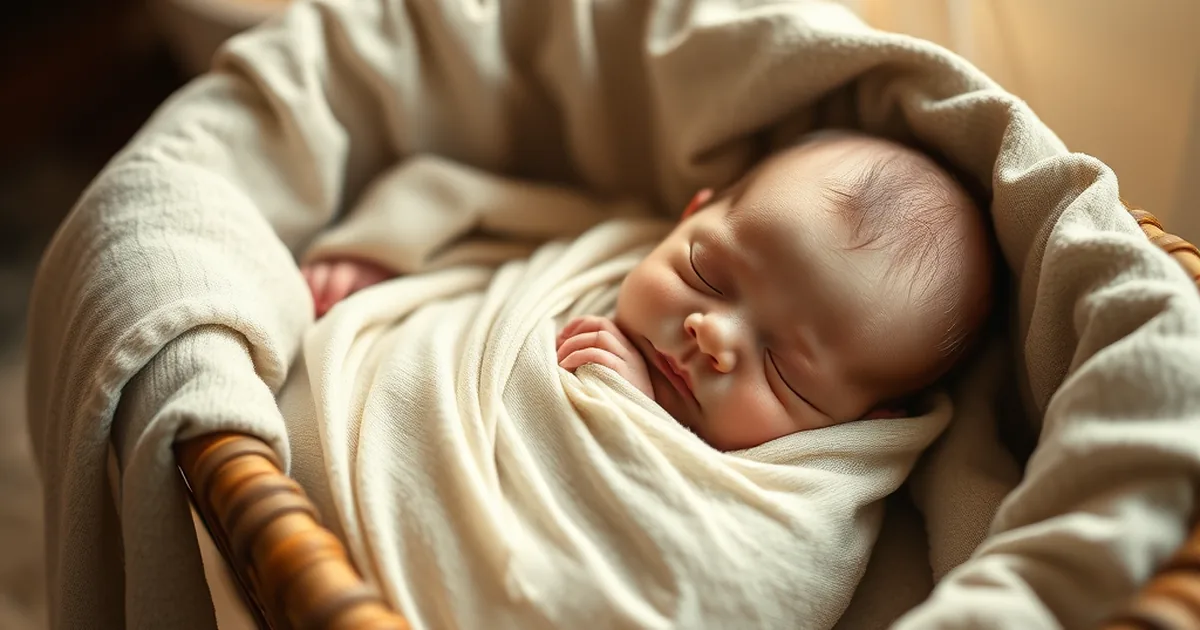
Swaddles reduce the startle reflex that wakes newborns in the first 8-12 weeks, mimicking the enclosed feeling of the womb and extending sleep stretches. The best swaddles are secure enough that the baby cannot break free, allow hip movement to meet safe hip development standards, and are easy to close quickly at 3 a.m. with one hand. Here are the four best baby swaddles of 2026.
Love to Dream Swaddle UP Original
The Love to Dream Swaddle UP is the most distinctive swaddle on this list and the one that solves the most common swaddle objection from babies themselves: it lets the arms up. Most newborns instinctively try to bring their hands to their face, and traditional arms-down swaddles fight that reflex, which is why many babies who resist swaddling are actually resisting the arm restraint rather than the enclosure. The Swaddle UP's wing-shaped arm pockets hold the arms in an upright position beside the head, so the baby can self-soothe by touching their cheek or sucking a fist while still being snugly contained and prevented from a full startle.
The swaddle is a single-piece zip-up garment with no wraps, folds, or Velcro. Putting it on takes 10 seconds: feet in, arms into the wings, zip from bottom to top. The two-way zipper opens from the bottom for diaper changes without releasing the arms, which is the feature most parents mention as the reason they never went back to wrap-style swaddles. The stretch cotton fabric has enough give for the baby to move within the swaddle without loosening it.
Love to Dream sells the Swaddle UP in Lite (0.2 TOG for warm rooms), Original (1.0 TOG for standard rooms), and Warm (2.5 TOG for cold rooms) so the swaddle matches room temperature without layering. Sizes run newborn (5-8.5 lb), small (8-13 lb), medium (13-19 lb), and large. The company also sells a Transition Bag with zip-off wings for the move to arms-out sleep, which allows one arm out at a time over several nights.
At $34.99, the Swaddle UP Original is mid-range on this list. For babies who fight arms-down swaddles, it is often the swaddle that finally works, and the zip-up format is the fastest to put on of any option here.
Best for: Babies who resist arms-down swaddling and self-soothe by bringing hands to their face, with a 10-second zip-up design.
Arm position: Arms up beside the head
Closure: Two-way zipper (diaper changes without unswaddling)
Price: $34.99
HALO SleepSack Swaddle
The HALO SleepSack Swaddle is the most widely used swaddle in US hospitals and the safest choice for parents who want a swaddle that meets the exact standards used in newborn nurseries. HALO supplies its SleepSack products to more than 1,500 hospitals, and the swaddle is designed around three safety priorities: a hip-healthy sack bottom that leaves the legs free to bend and flex, an inverted zipper that unzips from the bottom for diaper changes, and adjustable fastener wings that allow a secure arms-in swaddle, a one-arm-out transition, or a fully arms-out sleep sack as the baby grows.
The three-way swaddle wing system is the HALO's core feature. The wings wrap across the chest and fasten with hook-and-loop closures that can be tightened to the baby's size, so the swaddle stays snug on a 6-lb newborn and a 12-lb three-month-old with the same garment. When the baby starts to roll, the wings fold down under the arms and fasten across the chest, converting the swaddle to a wearable blanket with the arms free. This built-in transition is why many families use only one HALO from birth through 6 months.
The fabric options include 100 percent cotton (1.5 TOG), micro-fleece for cold rooms, and a Platinum series with a quilted cotton for standard rooms. The hook-and-loop closures are loud when opened, which can wake a light-sleeping baby during a middle-of-the-night diaper change; the inverted zipper mitigates this by allowing changes without opening the wings.
At $39.99, the HALO SleepSack Swaddle is competitively priced for a garment that handles the full swaddle-to-sleep-sack transition in one piece. For parents who want the hospital-standard safety design with the least number of products purchased over the first 6 months, it is the most practical choice.
Best for: Parents who want the hospital-standard hip-healthy swaddle that converts in place to a one-arm-out transition and then to an arms-free sleep sack.
Arm position: Arms in, one arm out, or arms out (adjustable wings)
Safety: Hip-healthy sack bottom, used in 1,500+ hospitals
Price: $39.99
The Ollie Swaddle
The Ollie Swaddle is the best swaddle on this list for babies who break out of every other swaddle. It was designed by a foster mother for an infant who could escape every commercial swaddle available, and its two features address the escape problem directly: a custom moisture-wicking stretch fabric with more elastic recovery than standard cotton, and a wide hook-and-loop closure panel that runs the full width of the chest so it can be tightened uniformly rather than at a single narrow point. A baby who Houdinis out of a standard swaddle by wriggling one arm free will find the Ollie's tighter, more even hold significantly harder to defeat.
The Ollie is a one-size design that fits from newborn through approximately 6 months by adjusting the closure width, which eliminates the sizing-up purchases that fixed-size swaddles require. The bottom of the swaddle is open with an elastic-cinched opening, so diaper changes happen by lifting the bottom hem without opening the closure. The open bottom also improves airflow, and the moisture-wicking fabric is the reason the Ollie is frequently recommended for babies who overheat in cotton swaddles.
The Ollie is sold with a mesh laundry bag to protect the hook-and-loop panel in the wash. It comes in a limited range of solid colors. Because it is a single-size design, it is also the swaddle most often passed between siblings and resold, which offsets some of the higher price.
At $64.99, the Ollie Swaddle is the most expensive swaddle on this list. For parents whose baby has escaped a HALO or a muslin wrap and whose sleep is suffering for it, the Ollie is the escape-proof option, and one Ollie replaces the two or three sizes of a fixed-size swaddle over the same period.
Best for: Babies who break out of standard swaddles, with a full-width closure panel and elastic-recovery fabric that holds a uniform tight wrap.
Sizing: One size, newborn to 6 months
Fabric: Custom moisture-wicking stretch (for babies who overheat)
Price: $64.99
Nested Bean Zen One Gently Weighted Swaddle
The Nested Bean Zen One is the best swaddle on this list for babies who settle only when a parent's hand is resting on their chest. The Zen One includes a lightly weighted pad (approximately 1 ounce, sewn into the chest of the swaddle) positioned where a caregiver's hand would rest. The weight is a fraction of the baby's body weight and is designed to simulate the touch that soothes a newborn to sleep without a parent standing at the crib with a hand in place until the baby is deep enough asleep to withdraw it. For babies who wake the moment a parent's hand leaves their chest, the Zen One addresses that specific pattern.
The Zen One is a convertible design with removable arm sleeves: fully swaddled with arms in, one arm out for transition, or both arms out as a weighted sleep sack. The mesh underarm panels improve airflow and reduce overheating. The two-way zipper allows diaper changes from the bottom. Sizes cover 0-3 months and 3-6 months, and Nested Bean sells a Zen Sack (arms-free weighted sleep sack) for 6-24 months as a continuation product.
The weighted design has drawn scrutiny. In 2024, the AAP and CPSC advised against weighted infant sleep products, citing insufficient safety evidence, and several major retailers pulled weighted sleep sacks in response. Nested Bean maintains the weight is light enough to be safe and that the Zen One meets all federal standards. Parents should discuss weighted sleepwear with their pediatrician before use, and should not use the Zen One for premature infants, low-birth-weight infants, or any baby with respiratory concerns.
At $44.99, the Nested Bean Zen One is priced between the HALO and the Ollie. For families whose pediatrician has no objection and whose baby demonstrably settles with chest pressure, the Zen One is the only swaddle on this list that addresses that specific soothing need.
Best for: Babies who settle with a hand on the chest, where a lightly weighted chest pad simulates that touch; discuss with your pediatrician before use.
Arm position: Convertible (arms in, one out, both out)
Weight: Approximately 1 ounce chest pad
Price: $44.99
How to Choose a Baby Swaddle
Arms up, arms down, or convertible?
Arms-down swaddles (HALO, Ollie, Nested Bean) most fully suppress the startle reflex and produce the longest sleep stretches in babies who tolerate them. Arms-up swaddles (Love to Dream) work for babies who fight arm restraint and want to self-soothe with their hands. Convertible swaddles (HALO, Nested Bean) handle the arms-out transition without buying a second product. If your baby is not yet born, a convertible arms-down swaddle is the safest first purchase; if your baby is already resisting an arms-down swaddle, switch to arms-up before giving up on swaddling.
When must swaddling stop?
Swaddling must stop as soon as the baby shows any sign of attempting to roll over, which typically occurs between 8 weeks and 4 months. A swaddled baby who rolls to their stomach cannot use their arms to push up and reposition, which creates a suffocation risk. The AAP recommends stopping at the first sign of rolling, not waiting for a successful roll. Convertible swaddles with a one-arm-out mode let parents transition gradually over 3-7 nights rather than removing the swaddle all at once.
What TOG rating does the nursery need?
TOG measures thermal insulation. A 0.2-0.5 TOG swaddle is for rooms above 75 degrees Fahrenheit, 1.0 TOG for 69-74 degrees, and 2.5 TOG for rooms below 68 degrees. Overheating is a SIDS risk factor, so the swaddle should be matched to the room, not to the season. A baby wearing a 1.0 TOG swaddle in a 70-degree room typically needs only a short-sleeve bodysuit underneath. Check the back of the neck: if it is sweaty, the baby is too warm.
Frequently Asked Questions
Is swaddling safe?
Yes, when done correctly: the baby is placed on their back, the swaddle is snug across the chest but loose at the hips, the baby is not overheated, and swaddling stops at the first sign of rolling. Hip-healthy swaddles (all four on this list) leave the legs free to bend up and out, which the International Hip Dysplasia Institute requires for safe swaddling. Tight leg wrapping in a straight position is associated with hip dysplasia and should be avoided with any swaddle, including blankets.
How tight should a swaddle be?
Snug enough that the baby cannot free an arm, loose enough to slide two fingers between the swaddle and the baby's chest. The hips and legs should be able to move freely. If the baby's breathing looks labored or the chest cannot expand fully, the swaddle is too tight. With hook-and-loop swaddles (HALO, Ollie), the closure should be firm but not stretched to its limit; with zip swaddles (Love to Dream), the fit comes from choosing the correct size.
Can you swaddle with a regular blanket instead?
Yes, and hospitals teach the technique at discharge. The disadvantages of blanket swaddling are that it takes practice to get tight enough to hold, it loosens as the baby moves, and a loose blanket in the crib is a suffocation hazard if it comes undone. Purpose-made swaddles eliminate the loosening problem and are faster to apply at night. For most families, one or two purpose-made swaddles are a worthwhile purchase for the 2-4 months they are used.