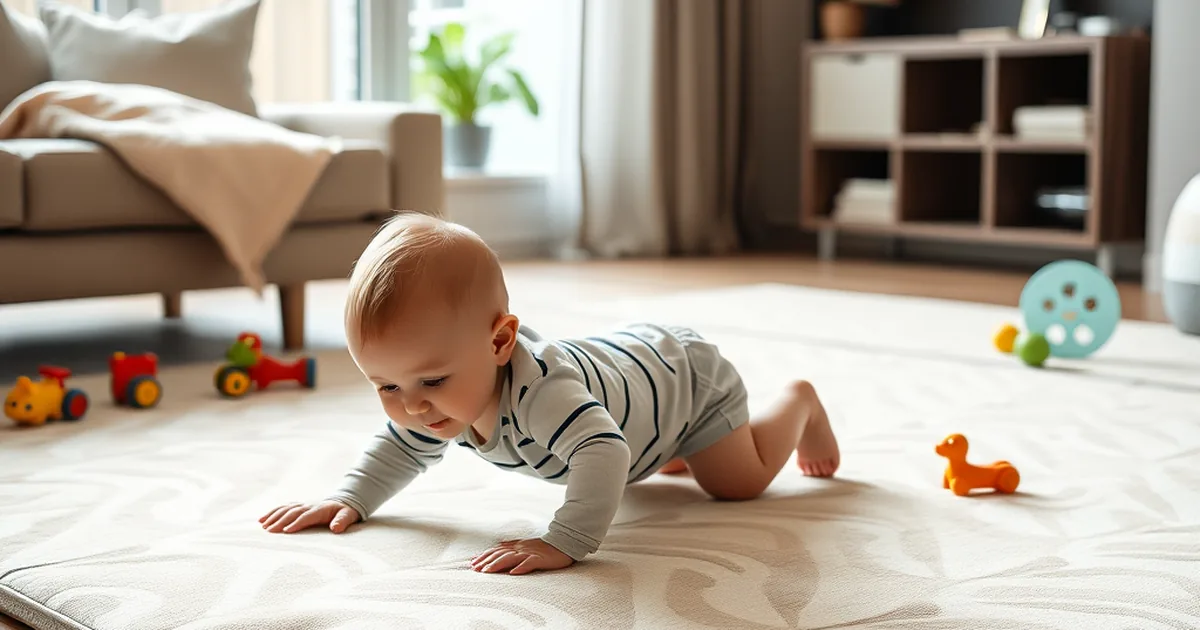
Baby play mats give crawlers and new walkers a padded surface over hard floors, cushioning falls and providing a clean, defined play area. The best mats are thick enough to absorb a toddler's tumble, made from materials that are safe to mouth, easy to wipe down, and designed to look like part of the room rather than a foam puzzle. Here are the four best baby play mats of 2026.
Toddlekind Prettier Playmat
The Toddlekind Prettier Playmat is the best-looking play mat on this list and the one for families who refuse to have a primary-colored foam puzzle in the living room. Toddlekind designs its mats with the patterns of Persian rugs, cement tiles, and Scandinavian textiles, printed on interlocking foam tiles so the assembled mat reads as a rug rather than baby gear. For homes where the play area is the living room, the Prettier Playmat is the product that resolves the conflict between decor and a safe floor.
The mat is 0.6 inches thick, made from EVA foam that is free from formamide, phthalates, and BPA and certified to European toy safety standards. The tiles interlock with a border kit so the edges are straight, and the surface is a low-sheen finish that is wipeable but not slippery under crawling knees. The standard set assembles to 47 by 71 inches, and multiple sets can be joined for a larger area.
The foam tiles come apart for cleaning under a tap and dry quickly. Because the pattern is printed, it will show wear at high-traffic spots after a year or two of daily use, which is the trade-off for a mat that looks like a rug. The mat is thick enough for crawling and first steps but is a hard-floor cushion, not a gymnastics mat.
At $199.99, the Toddlekind is the most expensive play mat on this list. For families who want a play mat that looks like a rug in a shared living space, it is the only option here that achieves that, and it is the reason to pay more.
Best for: Families who want a play mat that reads as a designer rug in a shared living space, with printed patterns on certified EVA foam tiles.
Size: 47 by 71 inches (expandable)
Thickness: 0.6 inches, interlocking tiles
Price: $199.99
Little Bot Ofie Mat
The Little Bot Ofie Mat is the best one-piece play mat on this list and the one most recommended for families concerned about material safety. The Ofie is a single, seamless mat rather than interlocking tiles, which eliminates the seams where crumbs collect and the small pieces that a toddler can pull apart. It is made from a TPU-coated foam that Little Bot tests for formamide, phthalates, heavy metals, and VOCs, and it is one of the few play mats certified to the stricter US standard for children's products.
The Ofie is 0.55 inches thick, which is enough to cushion crawling and toddler falls, and it is reversible with a different design on each side, typically a muted geometric print on one side and a solid or subtle pattern on the other. The surface wipes clean with a damp cloth; the seamless construction means there is nowhere for spilled milk to hide. The mat rolls for storage and lies flat again within a few hours.
The standard Ofie is 47 by 71 inches, and a larger version is available. The one-piece design means the size is fixed; families who want to cover an odd-shaped space cannot extend it with additional tiles. The Ofie is also heavier than tile mats, which matters only for families who move it between rooms daily.
At $149.99, the Little Bot Ofie is priced below the Toddlekind and above the tile-based options on this list. For families who want a seamless, reversible mat with the most rigorous material safety testing in the category, the Ofie is the clear choice.
Best for: Families who prioritize material safety and want a seamless one-piece reversible mat with no seams or removable pieces.
Size: 47 by 71 inches, one piece, reversible
Thickness: 0.55 inches, TPU-coated foam
Price: $149.99
Yay Mats Extra Large Play Mat
The Yay Mats Extra Large is the best play mat on this list for covering a large area, and the one for families whose toddler has a dedicated playroom or a big living room where a 4-by-6-foot mat leaves too much hard floor. The Yay Mats set assembles to 6 by 6 feet with interlocking tiles, twice the coverage of the Toddlekind and Ofie, and it does so at a price comparable to the smaller mats. The tiles are printed with subtle patterns in neutral tones, so the mat is unobtrusive even at that size.
The tiles are 0.5 inches thick, EVA foam certified free from formamide and phthalates, and they interlock tightly enough that a toddler does not pull them apart easily. The set includes straight-edge border pieces for a finished look. Tiles can be removed for cleaning and rearranged to fit an L-shaped space or work around furniture, which the one-piece Ofie cannot do.
Because the coverage is large, the Yay Mats set takes longer to assemble (about 15 minutes) and to take apart for a deep clean. The surface is smooth and easy to wipe. Like all printed foam tiles, it will show wear at heavy-use spots over time. The tiles are compatible with additional Yay Mats sets for even larger coverage.
At $129.99 for 36 square feet, the Yay Mats set is the best value per square foot on this list. For families who want to cover a playroom floor or a large living area, and who want tiles they can rearrange around furniture, the Yay Mats set is the practical choice.
Best for: Playrooms and large living areas needing 6-by-6-foot coverage, with rearrangeable tiles that fit around furniture.
Size: 72 by 72 inches (36 square feet)
Thickness: 0.5 inches, interlocking tiles
Price: $129.99
Skip Hop Doubleplay Reversible Playmat
The Skip Hop Doubleplay is the best-value play mat on this list and the most widely available, sold at every major baby retailer. It is a single-piece reversible foam mat with a modern geometric pattern on one side and a solid color on the other, in a choice of neutral colorways. The Doubleplay is 0.5 inches thick, made from EVA foam free from phthalates and formamide, and it rolls for storage.
At 50 by 70 inches, the Doubleplay is a similar size to the Toddlekind and Ofie. The one-piece construction eliminates seams and small pieces. The surface is smooth and wipes clean, and the mat has a slightly cushioned feel under crawling knees without being soft enough to compromise balance for a new walker. The mat lies flat out of the box, with only minor curling at the edges that resolves within a day.
The Doubleplay is the simplest mat on this list: it has no expandability, no premium design pretensions, and no third-party safety certification beyond the standard US requirements. What it offers is a well-made, attractive, reversible mat at a price that makes it an easy addition to a registry. It is thinner than the Toddlekind and Ofie by a small margin.
At $79.99, the Skip Hop Doubleplay is the most affordable mat on this list by a wide margin. For families who want a one-piece reversible mat without paying for designer prints or expanded certifications, it is the default that most families are happy with.
Best for: Families who want a simple, reversible one-piece mat at the lowest price, widely available at every baby retailer.
Size: 50 by 70 inches, one piece, reversible
Thickness: 0.5 inches
Price: $79.99
How to Choose a Baby Play Mat
One-piece vs. interlocking tiles
One-piece mats (Ofie, Skip Hop) have no seams to collect crumbs, no small pieces for a toddler to pull apart, and they roll for storage. Tile mats (Toddlekind, Yay Mats) can be sized and shaped to the room, individual tiles can be replaced if damaged, and they pack smaller. For a fixed rectangular space, one-piece is simpler. For an odd-shaped room or a large area, tiles are more practical.
How thick should a play mat be?
Half an inch is enough to cushion crawling knees and the falls of a new walker on a hard floor. Thicker mats (0.75 inches and up) are softer but can be unstable under a wobbly toddler. Mats under 0.4 inches are little better than a rug. All four mats on this list are in the 0.5 to 0.6 inch range, which is the sweet spot for the crawling-to-walking period.
What material safety certifications matter?
Look for foam that is tested free from formamide (a byproduct of EVA foam manufacturing that some countries restrict), phthalates, and BPA. In the US, children's products must meet CPSIA requirements. Some brands (Little Bot) go further with independent lab testing for VOCs and heavy metals. If the mat has a strong chemical smell out of the box, air it out for several days before use; a persistent odor is a reason to return it.
Frequently Asked Questions
When do babies need a play mat?
From the start of tummy time (a few weeks old) through the early walking phase (12-18 months). Newborns benefit from a defined, clean surface for tummy time; crawlers benefit from padding on hard floors; new walkers benefit from a cushion for the frequent falls of the first months on their feet. Most families use a play mat daily from about 3 months to 2 years.
How do you clean a baby play mat?
Wipe daily with a damp cloth and mild soap. For a deeper clean, one-piece mats can be wiped down with diluted vinegar or a baby-safe cleaner and air-dried; tile mats can be pulled apart and rinsed under a tap. Do not use bleach, which degrades foam, and do not put foam mats in a washing machine or dryer. Let the mat dry fully before putting it back on the floor to prevent moisture trapping underneath.
Can a play mat go on carpet?
Yes. A play mat on carpet adds a wipeable surface for spit-up and spills, which carpet does not provide. The padding is less important on carpet than on hardwood or tile, so a thinner mat is fine. Tile mats may shift on thick carpet; one-piece mats stay put better.