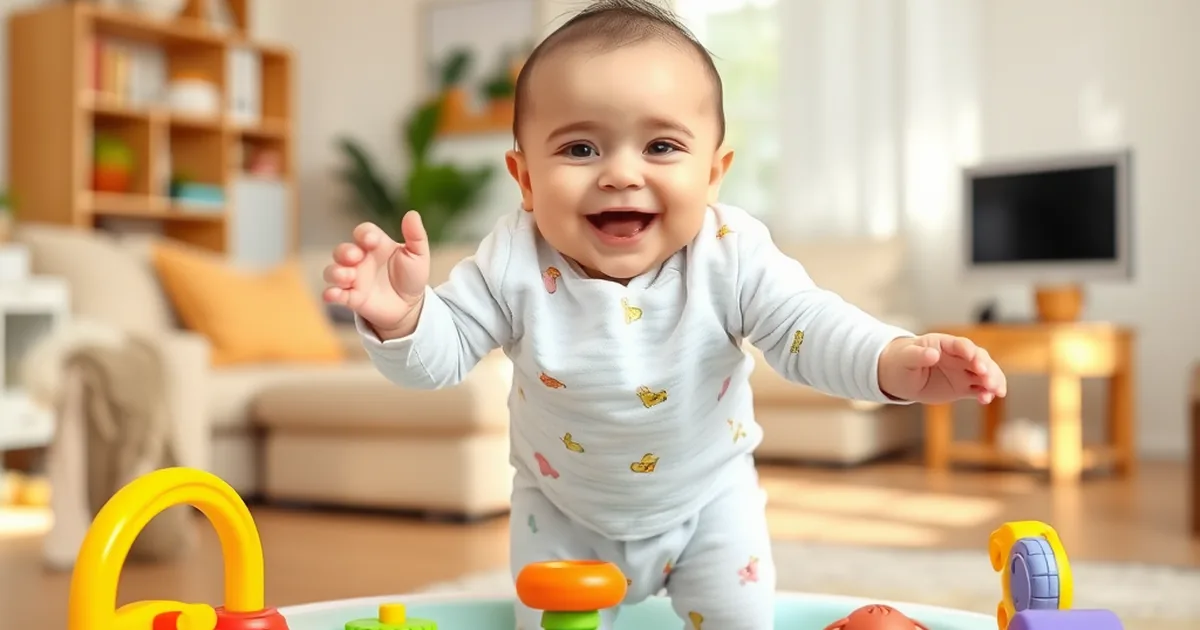
Baby activity centers and jumpers give a 4-12 month old a safe, contained place to stand, bounce, and play with attached toys while a parent has both hands free. The best models support the baby at the correct height so feet rest flat, keep bouncing gentle enough for developing hips and spine, and convert to a play table or walk-around activity center that extends use past the jumping months. Here are the four best baby activity centers and jumpers of 2026.
Skip Hop Explore and More 3-Stage Activity Center
The Skip Hop Explore and More is the activity center most frequently recommended by pediatric physical therapists, and the reason is the platform: instead of a hanging fabric seat that suspends the baby with toes dangling, the Skip Hop has a firm, height-adjustable platform under the baby's feet so the baby stands flat-footed and bounces from the legs. Physical therapists raise the concern that suspended jumpers encourage toe-standing and can promote tight calf muscles; the Explore and More is designed around the opposite posture, with the baby bearing weight through flat feet, which is the position that supports normal gait development.
The seat rotates 360 degrees so the baby can reach every toy around the tray, and the platform adjusts to three heights as the baby grows. The "Discovery Window" under the tray lets the baby see their own feet on the platform, which Skip Hop cites as a body-awareness feature. The toys include a piano with light-up keys, a spinning ball, a clacking owl, and a bead track; the piano's volume has a low setting.
The three stages are: activity center for 4 months and up (sitting and standing with support), a cruising table when the seat is removed and the tray becomes a flat play surface at pull-up height, and a clean play table with the toys removed for toddler use at 12 months and beyond. The frame folds flat for storage. The seat fabric is machine-washable.
At $119.99, the Skip Hop Explore and More is the most expensive activity center on this list. For parents who want the flat-foot platform posture that physical therapists prefer, and three stages of use from 4 months through toddlerhood, it is the most developmentally considered option available.
Best for: Parents who want a flat-foot platform posture preferred by physical therapists, with three stages of use from 4 months into toddlerhood.
Seat: 360-degree rotating seat over a firm adjustable platform
Stages: Activity center, cruising table, play table
Price: $119.99
Fisher-Price Rainforest Jumperoo
The Fisher-Price Rainforest Jumperoo is the best-known baby jumper in the United States and the most-registered product in the category. It is a freestanding jumper: the seat hangs from three spring-loaded arms on a tripod frame, so the baby bounces by pushing off the floor with their feet. Unlike doorway jumpers, the Jumperoo does not depend on a door frame and cannot swing into the door jamb, which is why the AAP's guidance against doorway jumpers does not apply to it. The bounce is springy and satisfying to babies, and the Rainforest has more toys and lights than any other jumper on this list.
The seat rotates 360 degrees and the frame adjusts to three heights. The toy tray includes a light-up monkey, a spinning lizard, a bead track, a rattling parrot, and a tray of rainforest animals that trigger music and lights when the baby bounces. The music has a volume control and can be turned off. The seat pad is machine-washable.
The Jumperoo's seat suspends the baby, so the baby's feet touch the floor at the toes or ball of the foot rather than flat, which is the design difference between it and the Skip Hop. Pediatric physical therapists suggest limiting jumper sessions to 15-20 minutes at a time and no more than a couple of sessions per day, and adjusting the height so the feet reach the floor as flat as possible. Used within those limits, the Jumperoo is a well-loved product; used as a multi-hour containment device, it is not.
At $109.99, the Rainforest Jumperoo is priced just below the Skip Hop. For parents who want the classic bouncing jumper with the most toys and lights, and who will use it in short sessions, it is the product that babies in this age range consistently respond to most enthusiastically.
Best for: Parents who want a freestanding bouncing jumper with the most toys and lights, used in short 15-20 minute sessions.
Type: Freestanding spring jumper (no doorway needed)
Toys: 12+ activities with lights and music
Price: $109.99
Evenflo ExerSaucer Triple Fun Active Learning Center
The Evenflo ExerSaucer Triple Fun is the best activity center on this list for families who want a large play mat included, because it starts as a floor gym for a newborn and does not become a standing activity center until the baby is ready. The three stages are: a play mat with an overhead toy bar for tummy time from birth, a bounce-and-spin activity center from about 4 months once the baby holds their head steady, and a play table from 12 months. Buying one product that starts on day one rather than at 4 months is the ExerSaucer's advantage over the rest of this list.
The ExerSaucer seat sits inside a saucer-shaped base rather than hanging from springs. The base rocks gently on a dome, so the baby can rock, spin, and bounce with a softer, shallower motion than a spring jumper produces. The seat rotates 360 degrees and the base has three height settings. The baby's feet rest on the saucer floor, which is flatter than a spring jumper's suspension but softer than the Skip Hop's rigid platform.
The toys include a jungle theme with a spinning elephant, a light-up lion, a bead track, and a music module with volume control. The play mat is 26 inches across and the overhead toy bar removes when the product converts to the activity center. All fabric parts are machine-washable. The ExerSaucer does not fold, which is its main practical drawback in a small home.
At $99.99, the ExerSaucer Triple Fun is priced below the Skip Hop and the Jumperoo and includes the newborn play mat stage that neither offers. For families who want a single purchase from birth through the first year rather than a play gym now and an activity center later, the ExerSaucer's three stages provide the longest span of use.
Best for: Families who want one product from birth (play mat) through activity center to play table, with a rocking saucer base rather than springs.
Type: Saucer-based rocker, no springs
Stages: Newborn play mat, activity center, play table
Price: $99.99
Baby Einstein Neighborhood Symphony Activity Jumper
The Baby Einstein Neighborhood Symphony is the best value jumper on this list and the one with the strongest music and language content, which reflects Baby Einstein's brand focus. The jumper is a freestanding spring design similar to the Jumperoo, with a seat suspended from three arms over a stable base, but its toy set centers on a piano that plays real melodies in a choice of classical, jazz, and pop styles and introduces the names of instruments in English, Spanish, and French. For parents who prefer their baby's toys to have musical content beyond beeps and animal noises, the Neighborhood Symphony is the jumper built around that.
The seat rotates 360 degrees and adjusts to four heights, the most of any jumper on this list, which makes it easier to set the feet flat. The toy stations include the piano, a drum, a xylophone, a spinning ball, and a bead loop. Several toys detach for floor play. The seat pad is machine-washable, and the frame folds flat for storage, which the Jumperoo and ExerSaucer do not.
The bounce is springy like the Jumperoo's, with the same physical therapist guidance applying: keep sessions to 15-20 minutes, adjust height so the feet are as flat as possible, and do not use the jumper as extended containment. The Neighborhood Symphony's four-height range makes hitting the flat-foot position easier than on three-height jumpers.
At $89.99, the Baby Einstein Neighborhood Symphony is the most affordable jumper on this list. For parents who want a freestanding jumper with musical and multilingual content, four height settings, and a folding frame, it delivers more adjustability than the Jumperoo at a lower price.
Best for: Parents who want a freestanding jumper with real melodies and multilingual instrument names, four height settings, and a folding frame at the lowest price.
Type: Freestanding spring jumper, folds flat
Heights: 4 settings (most on this list)
Price: $89.99
How to Choose a Baby Activity Center or Jumper
Platform activity center vs. spring jumper
Platform centers (Skip Hop) and saucer rockers (Evenflo) support the baby's weight through the feet on a surface, encouraging flat-foot standing. Spring jumpers (Fisher-Price, Baby Einstein) suspend the baby and produce a bigger bounce that babies love, but the suspended posture tends to put weight on the toes. Physical therapists generally prefer platform designs and recommend short sessions in spring jumpers. Neither is harmful when used for brief periods a few times a day; the concern is with hours of daily use.
When can a baby start using an activity center?
When the baby can hold their head steady without support, typically 4-6 months. The baby's feet should touch the floor or platform; if the feet dangle, the baby is not ready or the height is set wrong. Use should stop when the baby can walk or when the baby reaches the manufacturer's weight limit (usually 25 lb), whichever comes first. Most babies use an activity center from about 5 months to 10-12 months.
Doorway jumpers: why they are not on this list
The AAP recommends against doorway jumpers, which hang from a clamp on the door frame. The clamp can fail, the baby can swing into the door jamb, and the deep bounce loads the spine in a way freestanding jumpers do not. All four products on this list are freestanding with a floor base.
Frequently Asked Questions
Are jumpers bad for baby development?
Not when used in moderation. The concern from pediatric physical therapists is with extended daily use in a suspended seat, which can encourage toe-standing and delay the floor time that builds core strength for crawling. Limiting sessions to 15-20 minutes, a couple of times a day, and making sure the baby also gets plenty of floor and tummy time addresses the concern. An activity center is a tool for a parent to shower or cook, not a place for the baby to spend the afternoon.
How long can a baby stay in a jumper?
Most physical therapists and the manufacturers themselves suggest 15-20 minutes per session and no more than two or three sessions a day. Signs the baby has had enough: leaning to one side, fussing, or slumping in the seat. Babies who are tired in a jumper lose the muscle control that makes the posture safe.
What is the difference between an activity center and a walker?
A walker has wheels and lets the baby move around the house; an activity center is stationary. The AAP recommends against wheeled walkers because they let babies reach stairs, stoves, and pools faster than a parent can react, and Canada has banned them since 2004. Stationary activity centers provide the same standing and playing opportunity without mobility. All four products on this list are stationary.